

Alia Bhatt's Mijwan Saree — How to Get the Ivory Chikankari Look
On 26 September 2026, Alia Bhatt walked as showstopper alongside Vicky Kaushal at Manish Malhotra's Mijwan fashion show at Taj Lands End, Mumbai — a runway that marked 15 years of Malhotra's partnership with the Mijwan Welfare Society. She wore an ivory embroidered lace saree built around traditional Chikankari work: fine thread embroidery and scalloped edges, finished with classic, traditional jewellery. Within a day, the look was being written up across entertainment press as "old-world glamour" — and it is worth understanding why the craft itself is the story here, not just the celebrity wearing it.

A note on honesty: this was a custom Manish Malhotra couture piece, made for a charity runway, and MySilkLove does not stock his label. What we can do is explain the craft it was built from — Chikankari is not a designer invention, it is a 200-year-old Lucknow embroidery tradition — and show you where that same handwork is available today, in sarees you can actually order.

About the saree style: what Chikankari actually is
Chikankari is a hand-embroidery tradition that traces back to Lucknow in the late 18th century, worked traditionally on a fine, pale base — muslin, georgette, or a light silk — so the white-on-white thread work reads as shadow and texture rather than colour. Karigars (embroiderers) use a set of roughly 30 traditional stitches, from the flat "taipchi" running stitch to the raised "murri" and "phanda" knots, to build motifs of paisleys, flowers and jaali (net-like openwork) entirely by hand. A single fine saree can take a karigar several weeks to finish.
The choice of Chikankari for the Mijwan show is not incidental. The Mijwan Welfare Society, founded by the poet Kaifi Azmi and run today by his daughter Shabana Azmi, trains rural women in Azamgarh, Uttar Pradesh in exactly this kind of hand embroidery as a livelihood — Malhotra's annual show exists to put that craft on a couture runway and fund it. An ivory saree with visible, unbleached thread work and scalloped edges is, in other words, the most literal possible tribute to the artisans the evening was raising money for.
This is also why ivory and off-white remain the classic Chikankari ground, even though the craft is worked on colour today. A pale, warm-white base lets the thread's texture catch light rather than compete with a printed or dyed pattern — the embroidery is the entire point, so the cloth underneath stays quiet.
How to style it
The blouse. Traditional Chikankari sarees are almost always paired with a self-tone or one-shade-deeper blouse — ivory saree with an ivory or bone blouse, sometimes with the same hand embroidery carried onto the sleeves. A contrast blouse (a bright colour against the pale ground) fights the whole point of shadow-work; keep the palette within one family and let the thread texture do the work.
The jewellery. Coverage of the look described "traditional jewellery" rather than a minimalist single piece, and that is the correct instinct for Chikankari specifically — unlike a modern pastel silhouette, this craft pairs naturally with kundan or polki-style gold, jhumkas and a maang tikka, because the aesthetic it belongs to is old-world rather than contemporary minimal. Silver and oxidised jewellery, by contrast, tend to read as too casual against fine hand embroidery.
The drape and edges. Scalloped borders — a wavy, petal-like finish rather than a straight hem — are a Chikankari and Lucknowi-craft signature, and they show best in a drape with a fuller, gently gathered pallu rather than a stiff, pressed fan. If your saree has a scalloped or laced edge, let the pallu fall open at the shoulder instead of pleating it tight; the border is meant to be seen moving.
Hair and makeup. Specific styling detail wasn't part of the published coverage of this look, so we won't invent it — but the general rule for old-world Chikankari dressing holds: soft, low-set hair (a bun or loose waves) and warm, muted makeup, so nothing outshines the white-on-white embroidery itself.

Shop similar sarees at MySilkLove
Here is what is in stock in ivory, off-white and cream right now, starting with the direct Chikankari match:
- Citrine Off White Woven Lucknowi Chikankari Saree — ₹5,595. The closest match to the Mijwan look: an off-white ground with tonal hand embroidery.
- Cultured Pearl White Embroidery Chikankari Patola Handloom Saree — ₹6,066. Pearl-white with Chikankari embroidery on a Patola-inspired handloom base; also tagged for receptions.
- Frost White Embroidery Chikankari Patola Handloom Saree — ₹6,000. A georgette-handloom pairing of the same two crafts, in a slightly cooler white.
- Sorrell Cream Woven Lucknowi Chikankari Saree — ₹5,595. Warmer cream ground, for anyone who finds pure white too stark against their skin tone.
- Swiss Coffee White Handloom Banarasi Silk Saree — ₹5,592. If you want the ivory register in a Banarasi zari weave instead of embroidery — heirloom weight, reception-ready.
- Pearl White Printed Organza Saree — ₹4,913. A lighter, sheerer route to the same palette.
- Ice White Muga Cotton Woven Saree — ₹5,699. Muga silk and cotton, for a crisp ivory-white that works well in daytime events.
- Pure White Zari Woven Paithani Saree — ₹5,610. The regional-weave alternative, with a gold zari pallu instead of embroidery.
Browse the full Chikankari Sarees collection or the wider White Sarees and Cream Sarees edits, filtered to in-stock pieces only.

FAQ
What did Alia Bhatt wear at the Mijwan fashion show 2026?
She wore a custom ivory saree by Manish Malhotra built on Chikankari hand embroidery, with scalloped edges and traditional jewellery, walking as showstopper with Vicky Kaushal on 26 September 2026 at Taj Lands End, Mumbai.
Why was Chikankari the right choice for the Mijwan show specifically?
The Mijwan Welfare Society, founded by Kaifi Azmi and led today by Shabana Azmi, trains rural women artisans in Azamgarh, Uttar Pradesh in traditional hand embroidery, including Chikankari-style work, as a livelihood. Manish Malhotra's annual show exists to showcase and fund that craft, so an ivory saree built entirely around visible hand embroidery is a direct nod to the artisans the event supports.
Can I get a similar look without a designer saree?
Yes. Chikankari is a centuries-old Lucknow craft available well outside couture — an ivory or off-white ground with tonal hand embroidery, paired with a self-tone blouse and traditional gold jewellery, reproduces the same register. The specific saree was one-of-a-kind, but the craft and the colour story are not.
Start with the Chikankari Sarees edit, or narrow by budget: ₹3,000–₹5,000 and ₹5,000–₹7,500.
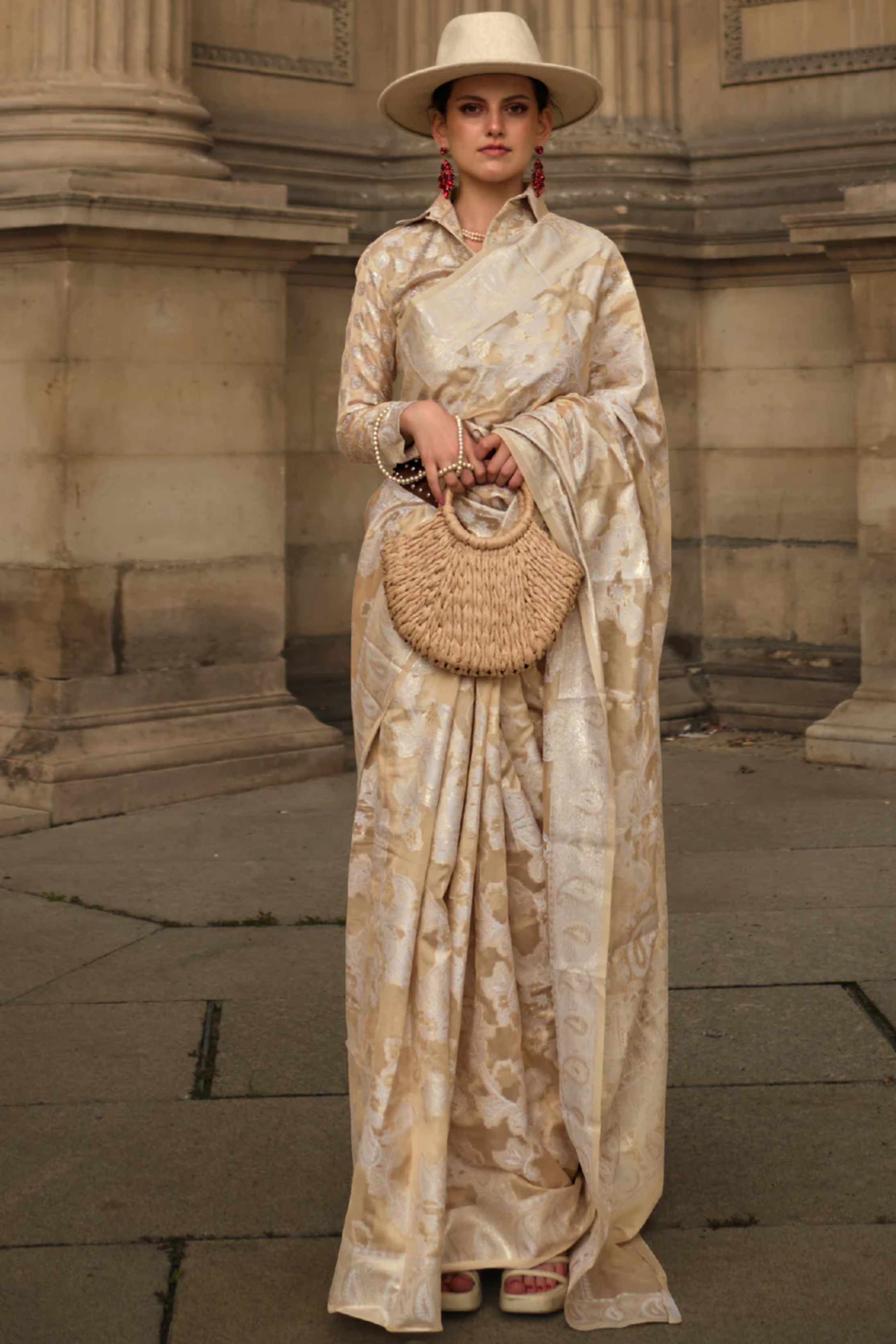
More shelves for an ivory, hand-finished look
The Chikankari, white and cream collections are linked above. Before you click through: the Cultured Pearl White, Frost White and Pearl White organza pieces in the list above are sold out at the moment, and several of the Chikankari shelf's bestselling pieces are unpublished. These shelves carry the rest of the look:
- Ivory in a Banarasi weave. Our ivory Banarasi sarees page is built from the Banarasi and cream colour tags and only lists pieces with stock on hand; cream Jamewar and handloom Banarasis lead its bestselling end.
- For a reception. Our reception sarees page only lists pieces with stock on hand. Embroidered Tussar Chikankaris share its bestselling end with a handloom satin Banarasi and Kanjivarams, and the Swiss Coffee White pictured above is on it too.


Leave a comment
This site is protected by hCaptcha and the hCaptcha Privacy Policy and Terms of Service apply.