
Pashmina Saree Price 2026: What You Actually Pay, and How to Read the Label
A pashmina saree costs between ₹3,326 and ₹6,807 at MySilkLove right now. Those are regular list prices; a seasonal auto-discount is applied at checkout, so what you actually pay is usually lower. And it is not a smooth range — the live shelf has exactly four price points, and what separates them is weave and origin, not a thread count on a tag.
The four price points, decoded
Every pashmina saree in stock today sits on one of four rungs. Here is what each one is:
| Price | What it is | Example |
|---|---|---|
| ₹3,326 | Woven pashmina saree — the soft-textured entry drape, cotton-based | Cornell Pink, Oriental Pink, Mandy Peach, Auburn Red |
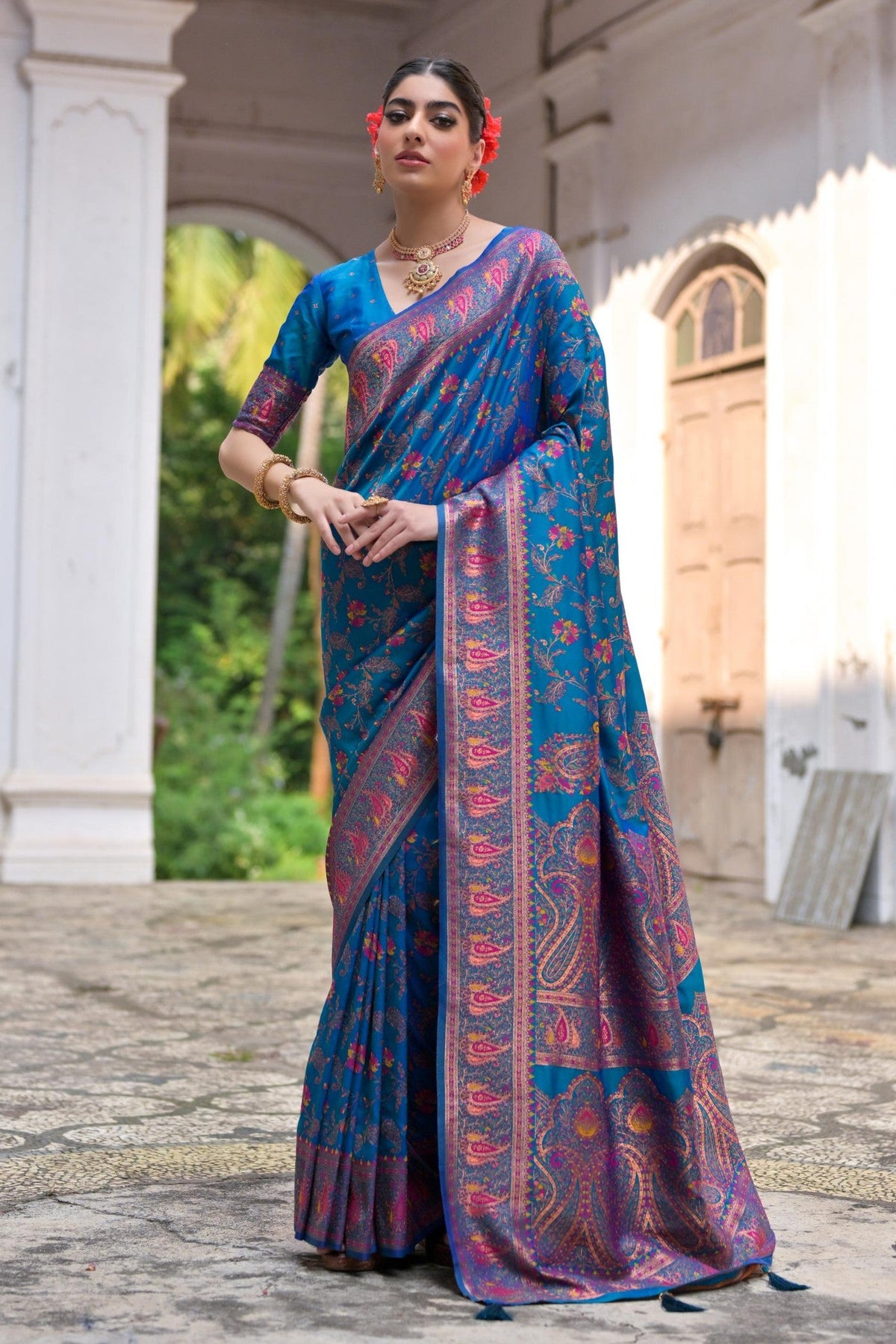
| ₹6,003 | Kashmiri handloom Jamewar saree — loom-woven paisley field | Celeste Blue, French Grey, Celadon Green, Dusky Black |
| ₹6,397 | Woven pashmina silk saree — silk-blend body, denser drape | Creole Black, Pine Green, Blue Chill, Amaranth Pink |
| ₹6,807 | Kashmiri handloom Jamewar — the fullest jamawar patterning | Warm Pink, Force Blue, Ivory Cream, Blackcurrant |
Notice the gap. There is nothing between ₹3,326 and ₹6,003 on the live shelf. If a listing offers you a ₹4,500 “pure pashmina saree,” that number is doing something — usually inflating a base price so a discount looks bigger.
Why “pashmina saree” almost never means Ladakhi pashmina
This is the part most price guides skip, and it is the single most useful thing to understand before you spend anything.
Real pashmina is the undercoat of the Changthangi goat, which lives above 4,500 metres on the Changthang plateau in Ladakh. The fibre it sheds each spring measures roughly 12 to 16 microns — finer than merino, finer than most cashmere. It is so fine and so short that it cannot survive the tension of a power loom. It has to be hand-spun on a yinder, a wooden spinning wheel, usually by women in Srinagar households, and then hand-woven. That is why Kashmir Pashmina received its GI tag in 2008, and why a genuine hand-spun pashmina shawl — not even a full six-yard saree — starts in the tens of thousands and runs into lakhs.
So a six-yard drape at ₹3,326 is not Ladakhi cashmere, and no honest seller should tell you it is. What you are buying is a pashmina-style weave: a fabric engineered to reproduce the matte surface, the soft fall and the paisley vocabulary of Kashmiri textiles, at a price you can actually wear to a wedding without insuring it. On our own shelf the ₹3,326 entry band is tagged cotton, and the ₹6,397 band is a silk-blend body. We list it that way on purpose.
That honesty is the point of this guide. Once you stop paying for a word, the four price points above become easy to choose between.
What ₹3,326 buys versus ₹6,807
At ₹3,326, you get the woven pashmina saree: light, matte, soft against the skin, with a quiet self-toned body and a restrained border. It drapes closer to a fine cotton than to a silk — it holds pleats but does not shine. This is the everyday-festive, office-Diwali, temple-visit end of the range, and it is genuinely comfortable in a way heavy silk is not.
At ₹6,003 and ₹6,807, you move into the Kashmiri handloom Jamewar sarees. Jamawar — from the Persian jama (robe) and war (yard) — is the paisley-and-vine idiom that made Kashmiri shawls a European obsession in the 1800s. The boteh, the curved teardrop motif, is the signature. The difference between the two rungs is coverage: the ₹6,807 pieces carry the denser, more continuous patterning, so the field reads as one composition rather than a border and a plain body.
At ₹6,397, the woven pashmina silk sarees split the difference — a silk-blend body gives you more weight and a low sheen, in solid jewel colours rather than paisley.
Four checks before you buy any pashmina saree
- Read the fibre line, not the product name. “Pashmina saree” is a style name in Indian retail. The composition field is the fact. If a listing will not tell you the composition, that silence is the answer.
- Be suspicious of the word pure. Pure pashmina at saree length, hand-spun and hand-woven, does not appear at four-digit prices. It is not a bargain you found; it is a claim someone made.
- Check whether the paisley is woven or printed. Turn the fabric over. A loom-woven jamawar shows the motif structure on the reverse, softened but present. A print stops at the surface.
- Ask what the price actually is. Our variant prices are regular list prices, and a seasonal offer is applied automatically at checkout — so the number you see is the honest ceiling, not an inflated one waiting to be slashed.
So which one should you buy?
If you want the pashmina feel for regular festive wear and you care about comfort over occasion-weight, take the ₹3,326 woven pashmina. If you want the piece people ask about — the Kashmiri paisley, the heirloom-looking one — go to the ₹6,807 handloom Jamewar and skip the rungs in between. The ₹6,003 and ₹6,397 bands are for a specific taste: less pattern, more colour.
Browse the full range in the pashmina sarees collection, or see the paisley weaves on their own in Kashmiri Jamawar sarees.
Shop by the price point you landed on
Each of the four rungs above maps to a shelf you can browse directly:
- The ₹3,326 entry rung sits inside our ₹3,000 to ₹5,000 saree edit, alongside the Kanjivaram, Banarasi and Chanderi weaves competing for the same budget.
- The ₹6,003 and ₹6,807 Jamewar rungs are loom-woven, so compare them against the rest of our handloom sarees before you decide the paisley is what you want.
- For the paisley field itself — the boteh, the vine, the paisley coverage that separates the two Jamewar rungs — go straight to Kashmiri Jamawar sarees and read the reverse in the product photographs.
Frequently asked questions
What is the price of a pashmina saree in India?
On our shelf, ₹3,326 to ₹6,807 as a regular list price, across four fixed price points. Prices elsewhere vary widely, largely because the word “pashmina” is used loosely.
Is a pure pashmina silk saree real?
Pashmina is goat fibre and silk is an insect filament, so “pure pashmina silk” is not a real single material — it describes a blended or pashmina-style silk weave. Treat the phrase as marketing, not composition.
Why is a genuine Kashmiri pashmina so expensive?
The fibre is hand-collected from Changthangi goats once a year, hand-spun because it breaks under machine tension, and hand-woven. A single shawl can take weeks. Saree lengths take far longer.
How do I care for a pashmina-weave saree?
Dry clean only, store folded in cotton or muslin rather than plastic, refold along different lines every few months so the creases do not set, and keep it away from direct sunlight. See our guide to storing sarees so they last.
Can I wear a pashmina saree to a wedding?
Yes — the ₹6,003 and ₹6,807 Kashmiri Jamewar pieces read as occasion wear. The ₹3,326 woven pashmina is better suited to daytime functions and festive-casual.


Leave a comment
This site is protected by hCaptcha and the hCaptcha Privacy Policy and Terms of Service apply.