
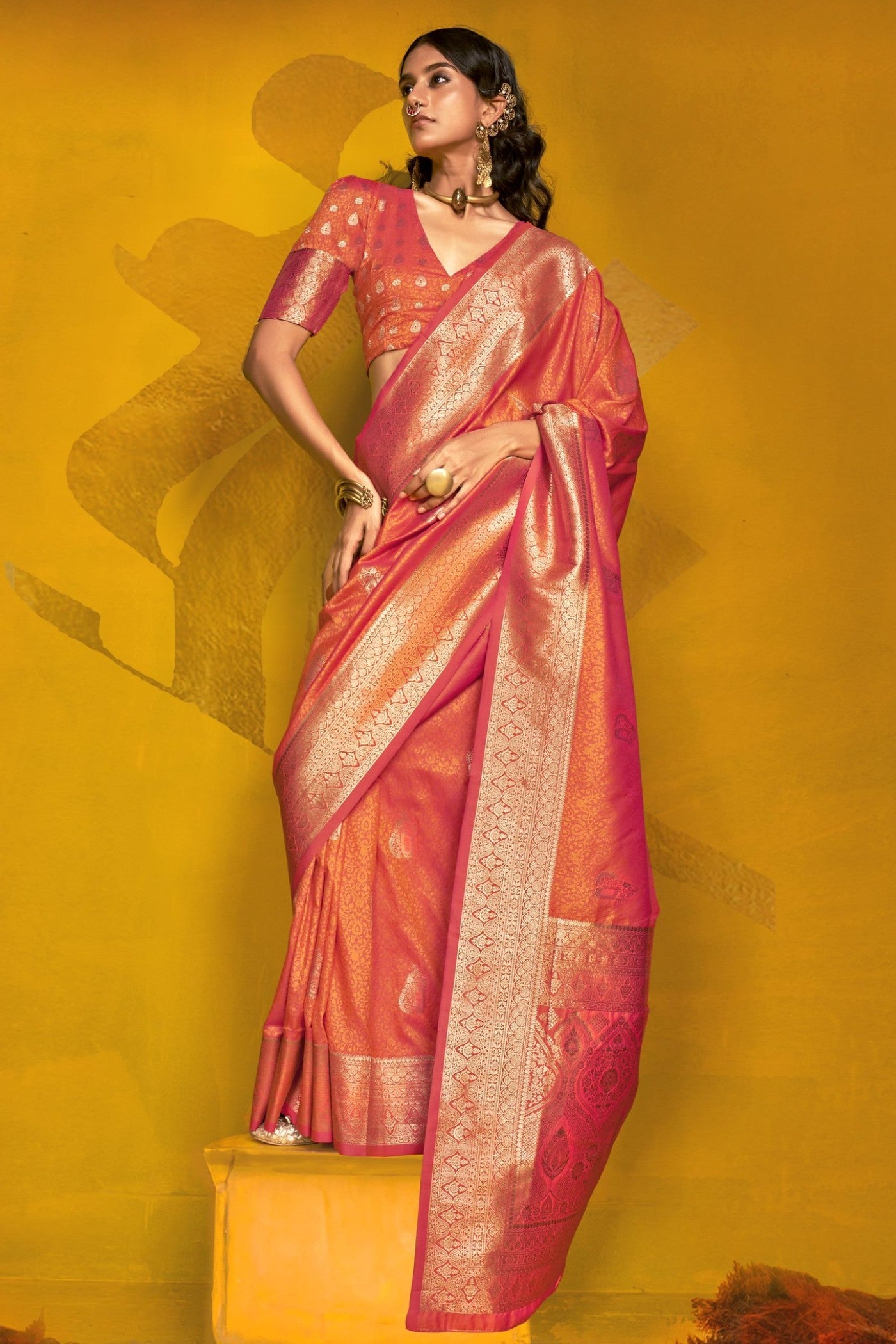
Banarasi Saree Price Guide 2026: What You Actually Pay at Each Tier
A Banarasi saree in India costs from about ₹2,800 to well past ₹50,000. That is a genuine 18x spread for what looks, in a photograph, like the same garment. The number is decided by three things and almost nothing else: what the base fibre actually is, how the motifs were put into the cloth, and what the “zari” is made of. Everything else — the shop, the city, the packaging — is noise.
Here is what each tier really buys you, using MySilkLove's live regular list prices (verified 17 August 2026; seasonal offers are applied automatically at checkout and usually bring the paid price lower).
The short answer: Banarasi price tiers in 2026
| Tier | Regular list price | What you are actually buying |
|---|---|---|
| Entry | ₹2,800 – ₹4,200 | Zari-woven Banarasi and Banarasi jacquard on art-silk or raw-silk blend bases. Powerloom or semi-automatic loom. Motif work is machine-repeated. |
| Mid | ₹4,200 – ₹6,000 | Banarasi handloom silk and Banarasi satin. Genuine loom time, heavier hand, cleaner border finishing. This is where most wedding-guest buying sits. |
| Upper | ₹6,000 – ₹10,550 | Woven designer Banarasi with dense brocade coverage, meenakari colourwork and wider borders. Our live ceiling sits at ₹10,569. |
| Collector | ₹15,000 – ₹50,000+ | Pure Katan handloom from Varanasi weaver families, often kadhua-woven, sometimes with real silver-gilt zari. Months of loom time per piece. |
Note the honest bit: MySilkLove's Banarasi range currently tops out at around ₹10,550. The collector tier above that exists in the market, but we would rather tell you where our range ends than pretend otherwise.
What actually drives the price
1. Kadhua vs fekua — the single biggest price fork
This is the detail almost no product page explains, and it is the one that separates a ₹4,000 Banarasi from a ₹40,000 one.
In kadhua weaving, every motif is woven as a separate, self-contained unit. The weaver stops, introduces the extra weft for that one buti, ties it off, and moves on. Turn the saree over and the reverse is clean — no loose threads running between motifs. It is painfully slow, and a densely kadhua-woven saree can take a weaver family several months.
In fekua (also sold as cutwork), one continuous extra weft is thrown right across the width of the cloth, and the float between motifs is snipped away afterwards. Far faster, far cheaper. Turn it over and you will see the cut float ends behind each motif.
Neither is fake. But kadhua costs multiples more, and if a listing at ₹3,500 implies kadhua work, the arithmetic does not hold.
2. Katan, blend, or something else entirely
“Banarasi” describes a weaving tradition from Varanasi, not a fibre. A Banarasi can be woven on pure Katan silk (twisted mulberry filament — the traditional base), on a silk blend, on raw silk, on satin, on georgette or on organza. All of these are legitimately Banarasi in technique. Only Katan is pure mulberry silk, and only Katan carries the pure-silk price.
If a saree is described as Banarasi and priced under about ₹5,000, it is almost certainly a blend or a non-Katan base. That is fine — it is what most people should buy — but the label should say so.
3. The zari
Modern zari is polyester film metallised with aluminium. Traditional kalabattu zari is silver wire, gilded with gold, wound on a silk core — and it is sold by weight, which is why old Banarasis were valued partly as bullion. Real gilt zari alone can add tens of thousands to a saree's cost. Below roughly ₹15,000, assume tested-and-certified modern zari.
The 20-second check before you pay
- Turn it over. Clean reverse with individually finished motifs = kadhua. Cut float threads = fekua. Uniform machine-perfect repeats with a bonded backing = powerloom.
- Check the selvedge. Handloom Banarasi has a slightly irregular selvedge and tiny variations in motif spacing. Perfect regularity across six yards is a loom, not a person.
- Ask for the base fibre by name. “Banarasi silk” is not an answer. “Katan”, “Khaddi georgette”, “raw silk”, “satin” are answers.
- Look for the GI mark. Banaras Brocades and Sarees hold a Geographical Indication registered in 2009. The GI covers a defined cluster around Varanasi — Chandauli, Bhadohi, Jaunpur, Mirzapur, Sant Ravidas Nagar and Azamgarh.
So what should you actually spend?
For a wedding guest or a festive occasion, the ₹4,200–₹6,000 handloom band is the honest sweet spot: real loom time, good drape, and no pretence about being an heirloom. For a bride or a once-in-a-decade purchase, the upper band buys visibly denser brocade coverage. Below ₹3,000 you are buying a well-made blended jacquard — a good saree, but call it what it is.
Browse the full range on our Banarasi sarees collection, or start with Banarasi sarees under ₹5,000 if you are working to a budget. For the same breakdown on a different weave, see our Patola saree price guide.
Shop the tiers
The Banarasi collection linked above is the broad route. These three pages follow the tiers in the table:
- The mid tier: handloom and satin Banarasi. Our handloom sarees page is built from the handloom tag and only lists pieces with stock on hand; Banarasi handlooms, including a handloom satin Banarasi, lead its bestselling end.
- Katan, by name. Our Banarasi katan silk sarees page groups sarees with katan in their name and only lists pieces with stock on hand. It is not the collector tier described above, so the checklist applies to it as to any listing: ask for the base fibre by name.
- A bride or a family-of-the-couple role. Our reception sarees page only lists pieces with stock on hand; a handloom satin Banarasi, a Kanjivaram and Tussar Chikankari pieces lead its bestselling end.
Frequently asked questions
What is a good price for a Banarasi saree?
For everyday festive wear, ₹4,200–₹6,000 buys genuine handloom Banarasi silk. Under ₹3,000 you are buying a blended or powerloom jacquard, which is perfectly good but should be priced and described accordingly.
Why are some Banarasi sarees ₹3,000 and others ₹50,000?
Loom time and fibre. A powerloom blend takes hours; a kadhua-woven pure Katan saree takes a weaver family months, and gilt zari is sold by weight. The cloth may look similar in a photo; the labour behind it is not comparable.
How do I know if my Banarasi is pure silk?
Ask for the base fibre by name — Katan is the pure mulberry option. On the cloth itself, pure silk has an uneven, slightly slubby sheen that shifts colour as you tilt it, while polyester reflects a flat, uniform shine. A Silk Mark tag, where present, is the reliable confirmation.
Is a cheaper Banarasi a fake Banarasi?
No. Banarasi refers to the weaving tradition, not a price point or a fibre. A ₹3,500 Banarasi jacquard is a real Banarasi-technique saree on a blended base. It becomes dishonest only when it is sold as pure Katan handloom.
Do Banarasi saree prices drop during festive sales?
Regular list prices stay stable; seasonal offers are applied automatically at checkout, so the amount you pay is usually below the listed figure. The prices in this guide are regular list prices as of 17 August 2026.


Leave a comment
This site is protected by hCaptcha and the hCaptcha Privacy Policy and Terms of Service apply.