
Crepe Saree Guide 2026: What Crepe Actually Is, and How to Buy One
A crepe saree is not defined by its fibre — it is defined by its twist. Crepe is a finishing technique, not a material. The yarn is over-twisted before weaving, and that twist is what gives the fabric its faintly pebbled surface, its heavy fluid fall, and its near-refusal to hold a crease. You can have silk crepe, satin crepe, georgette crepe and polyester crepe, and they will all behave differently. This guide explains what to actually look for, and what a crepe saree honestly costs.
What makes a fabric "crepe"
In a plain fabric, the warp and weft yarns sit relatively relaxed. In crepe, the yarns are twisted hard before they ever reach the loom — commonly in the region of 2,000 to 3,000 turns per metre — and S-twist and Z-twist yarns are alternated across the weft. Those opposing twists pull against each other when the woven cloth is finished, and the surface contracts very slightly into the grainy, sand-like texture that gives crepe its name.
That single structural fact explains almost everything buyers notice about crepe:
- It drapes downward, not outward. The twist adds weight and kills body, so a crepe saree clings and falls in narrow columns instead of standing away from you.
- It resists creasing. The contracted surface springs back, which is why crepe survives a long day and a folded suitcase far better than a crisp organza or tissue.
- It photographs flat. Crepe has a matte, light-absorbing surface. If you want shine, you want the satin face — see the next section.
Satin crepe vs plain crepe: the one distinction that matters
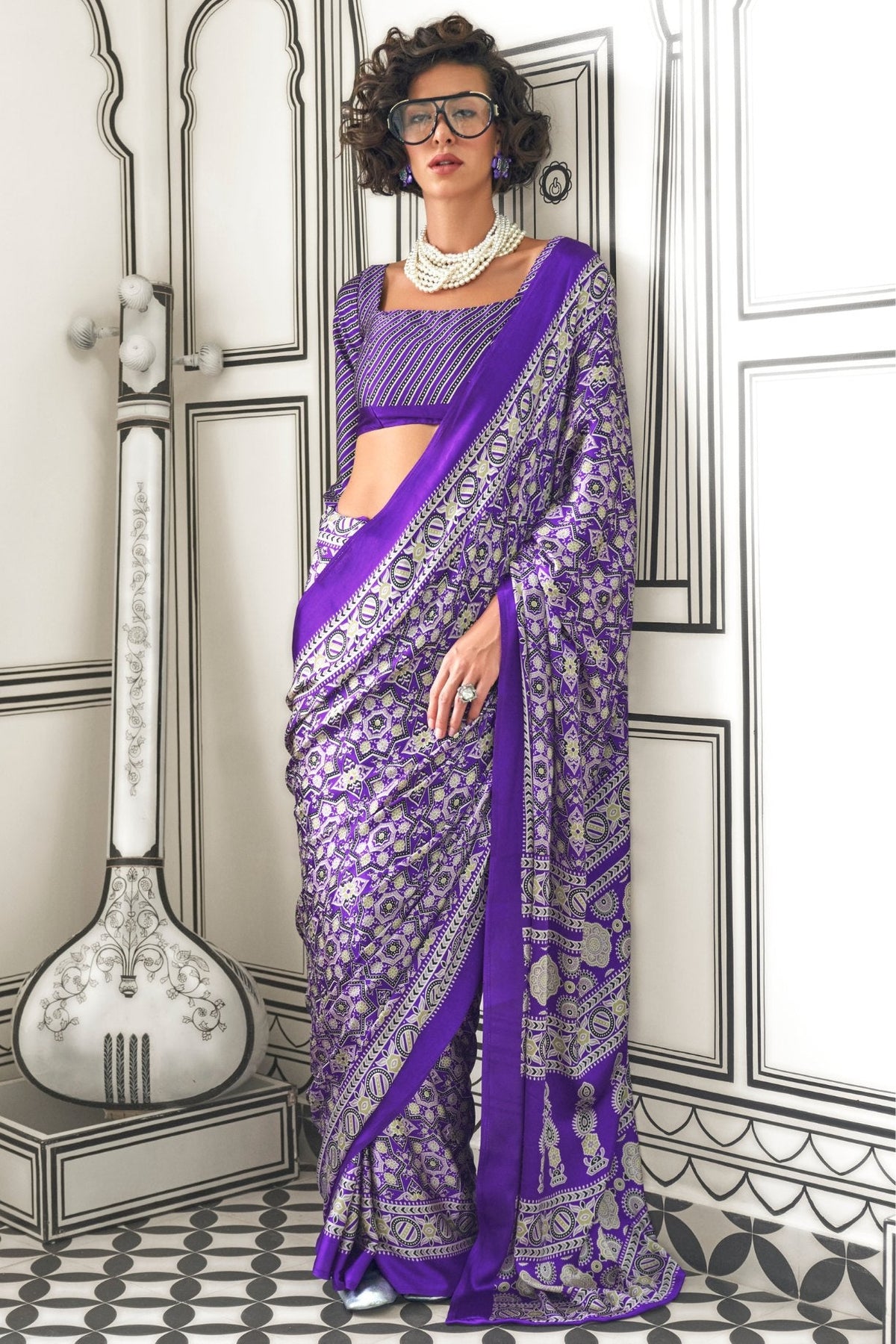
Most of what sells as a "crepe saree" in India today is satin crepe — a fabric with two different faces. One side is woven in satin and is smooth and reflective; the reverse is crepe and is matte and textured. It is the same cloth, finished two ways.
This matters when you buy, because satin crepe gives you the fluid crepe drape plus a soft sheen, which is why it reads as dressier than plain crepe in photographs and under evening light. Plain crepe stays entirely matte and reads quieter and more formal — better for office and daytime wear.
Neither is "better". But if a listing says only "crepe" and the image is visibly glossy, you are almost certainly looking at satin crepe.
What a crepe saree costs in 2026
Here is the honest range from our own live shelf rather than a market average. Across the crepe saree collection, in-stock pieces currently run from about ₹2,400 to around ₹3,950.
- ₹2,400–₹2,900 — the entry band. Ajrakh-printed satin crepe silk sarees sit here, including pieces that ship without a blouse piece at the lower end. This is where the best value is.
- ₹2,900–₹3,500 — printed satin crepe. Wider colour range, blouse piece included, stripe and floral print families.
- ₹3,500–₹3,950 — the top of the in-stock shelf. Printed polka-dot and multi-tone satin crepe sarees.
Those are regular list prices. Seasonal offers are applied automatically at checkout, so the amount you actually pay is frequently lower than the figure on the product page.
A note on honesty: crepe is a mid-price fabric by construction. If you are quoted ₹15,000 for a "pure crepe silk saree", you are paying for embroidery, designer work or a brand name — not for the crepe.
How to judge a crepe saree before you buy
1. Look at the fall in the photograph
Good crepe hangs in long vertical folds with no stiffness at the hem. If the saree in the image stands away from the model or shows sharp angular pleats, the twist is light and the fabric will not drape the way you expect.
2. Check the print method
Crepe takes print exceptionally well, which is why Ajrakh, Kalamkari-style and geometric prints dominate the category. On an Ajrakh-printed crepe, look for the indigo and madder palette and slight irregularity at the block edges — that irregularity is a sign of block printing rather than a flat digital reproduction.
3. Read the blouse-piece line
Several crepe sarees at the entry price ship without a blouse piece, and that is exactly why they are cheaper. This is stated on the product title or page. Factor in the cost of sourcing a blouse fabric separately before you compare two listings on price alone.
4. Do not expect handloom
Crepe is a power-loom fabric by nature — the twist levels involved are not achievable by hand at scale. Any listing that markets a crepe saree as handloom heritage weaving is overclaiming. If handloom is what you want, look at silk sarees and the traditional weave pillars instead.
Caring for a crepe saree
Dry clean the first time, then hand-wash cold in mild detergent if the piece is unembellished. Never wring it — the over-twisted yarn is exactly what distorts under torsion, and a wrung crepe saree develops permanent ripples along the pallu. Drip-dry in shade, and iron on low with a cloth barrier only if needed, which in practice is rarely.
Where crepe fits against similar fabrics
If you like crepe's fluidity but want more transparency and float, look at georgette sarees — georgette is also a twisted yarn fabric, but lighter and sheer. If you want the sheen without the texture, satin sarees give you a fully smooth face. And if the Ajrakh prints are the reason you came, the full Ajrakh saree edit runs across crepe, modal and cotton bases.
Frequently asked questions
Is crepe saree good for daily wear?
Yes — it is one of the better daily-wear options, because it resists creasing and does not need starching or frequent ironing. The matte finish also reads appropriately for office wear.
Is crepe real silk?
Not necessarily. Crepe describes the yarn twist, not the fibre. A saree can be silk crepe, blended crepe or fully synthetic crepe. Always read the fabric line on the product page rather than assuming from the word "crepe".
Does a crepe saree need a petticoat?
Yes, and choose a smooth one. Crepe clings, so a textured or bunched petticoat will show through the drape.
Does crepe suit heavier body types?
Crepe follows the body closely, so it defines shape rather than concealing it. If you prefer a looser silhouette, a lighter georgette or a structured cotton will be more forgiving.
Browse the full crepe saree collection — free shipping across India, cash on delivery available.
Where to go next
If the block-printed pieces are the reason you are here, the Kalamkari saree edit is where the hand-drawn and block-printed work sits — it is tag-built and inventory-gated, so what it shows is what the warehouse currently holds. For the wider print story described above, printed sarees runs across crepe, modal and cotton grounds. And because crepe's matte face and crease resistance make it a daily-wear fabric before it is a festive one, the office wear saree edit is the shelf to browse alongside it — or compare cotton sarees if you want the same easy handle in a breathable natural fibre.


Leave a comment
This site is protected by hCaptcha and the hCaptcha Privacy Policy and Terms of Service apply.