
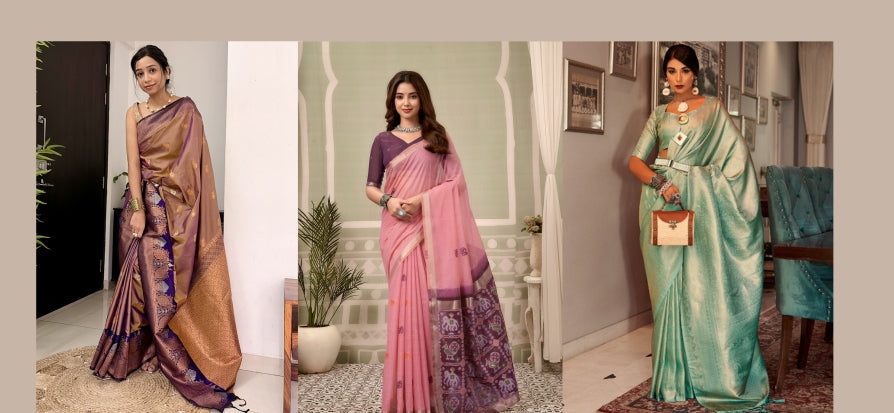
GI Tags in Indian Handloom – What They Mean and Why You Should Care
A GI tag handloom saree is more than a label — it is a legal guarantee that the saree you are buying was made in a specific region of India using traditional methods. GI stands for Geographical Indication, a form of intellectual property protection recognised under the TRIPS Agreement. For buyers, this means authenticity, heritage, and fair wages for weavers are all built into the price.
What Is a GI Tag and Why Does It Matter?
India's Geographical Indications of Goods (Registration and Protection) Act, 1999 allows textile clusters to register their traditional weaves as protected products. Once registered, only producers within that geographic area using the defined technique can legally market the product under that name. When you purchase a GI-tagged saree, you are buying a product whose origin and craft method have been verified by the Government of India.

Major GI-Tagged Handloom Sarees of India
Kanjivaram (Tamil Nadu)
Woven in Kanchipuram, Tamil Nadu, the Kanjivaram saree is made from pure mulberry silk sourced mainly from Karnataka. Its defining technique is the korvai method, where the border is woven separately and interlocked with the body — you can identify this by a ridge visible on the reverse of the saree. The zari used is pure silver coated with gold, giving the border its characteristic brightness. GI registration has been in place since 2005, protecting weavers and buyers alike. Browse our Kanjivaram collection.
Banarasi (Uttar Pradesh)
Banarasi sarees from Varanasi are celebrated for their intricate brocade work, where motifs are woven directly into the fabric using a supplementary weft technique. The meenakari style incorporates coloured silk threads alongside zari to create floral and Mughal-inspired patterns. Varieties include pure silk, organza, shattir, and georgette Banarasi, each with different textures but sharing the same GI registration. Explore Banarasi sarees.

Paithani (Maharashtra)
Paithani sarees from Paithan, Aurangabad, are instantly recognisable for their tapestry-woven peacock motif in the pallu and the characteristic oblique interlocking weft technique that creates a double-sided appearance. Pure silk Paithani uses silk warp and silk weft with real zari borders, and the weaving process can take weeks to months depending on the complexity. GI registration protects the term "Paithani" for sarees made in Aurangabad and Nashik districts. Shop Paithani sarees.
Pochampally (Telangana)
Pochampally ikat sarees, woven in Bhoodan Pochampally near Hyderabad, use a resist-dyeing technique where threads are tie-dyed before weaving so that the pattern emerges as the loom brings them together. The geometric diamond and chevron patterns are characteristic of Pochampally, and the precision required to align the dyed threads perfectly is what makes each saree unique. GI registration was granted in 2004.
Chanderi (Madhya Pradesh)
Chanderi sarees from Chanderi town in Madhya Pradesh are known for their sheer, lightweight body — a blend of silk warp and cotton weft — which gives them their characteristic translucency and fluid drape. Traditional Chanderi motifs include coins, florals, and peacocks, woven in fine zari. The GI tag covers both silk Chanderi and the more affordable cotton Chanderi variants. Browse Chanderi sarees.
Jamdani (West Bengal)
Jamdani, woven in the Dhaka-Narayanganj belt (with Indian production centred in Fulia and Shantipur, West Bengal), is a UNESCO Intangible Cultural Heritage of Humanity. The technique involves manually inserting supplementary weft threads to create geometric or floral motifs on a fine muslin base — no mechanical assistance, purely fingertip and shuttle work. Indian Jamdani received GI status in 2013.

Sambalpuri (Odisha)
Sambalpuri sarees from western Odisha are made using the bandha ikat technique, where warp and weft threads are both tie-dyed before weaving, creating a characteristic blurred-edge pattern across the entire saree body and border. Traditional motifs include shankha (conch), chakra (wheel), phula (flower), and deer. The GI tag covers sarees from the Sambalpur, Bargarh, Bolangir, and Sonepur districts.
Kota Doria (Rajasthan)
Kota Doria sarees from Kaithoon near Kota, Rajasthan, are defined by their distinctive square check pattern — called khat — created by weaving alternating squares of cotton and silk in the warp and weft. The resulting fabric is extremely lightweight, breathable, and semi-transparent, making it ideal for summer wear. GI registration was granted in 2005.
Madhubani (Bihar)
Unlike woven sarees, Madhubani sarees from the Mithila region of Bihar feature hand-painted or block-printed folk art directly on silk, cotton, or tussar fabric. The paintings use natural dyes and depict mythological scenes, flora, and fauna in a distinctive two-dimensional style with bold outlines. GI protection covers the art form itself, ensuring that only sarees painted in the Mithila region by trained artisans can carry the Madhubani GI label.

Kashmiri Kani (Kashmir)
Kani shawls and sarees from Kashmir are woven using the kani (twill tapestry) technique, where bobbins called kanis — one for each colour section — replace the conventional shuttle. This needlepoint-like weaving creates intricate paisley and floral patterns with exceptional detail, and a single pashmina Kani shawl can take a master weaver 12 to 18 months to complete. The GI tag protects the Kani weave for products made in the Kashmir valley.
How to Verify a GI Tag in Person
Buying a GI-tagged saree requires a few verification steps to ensure you are getting the real product:
- Look for the holographic GI sticker — Authentic GI products often come with a tamper-proof holographic sticker issued by the GI registry or the relevant weaver's cooperative. The sticker should have a unique serial number.
- Check for the Silk Mark label — The Silk Mark Organisation of India issues certification labels that confirm the fabric is pure silk. A Silk Mark label alongside a GI sticker is the strongest dual verification you can have.
- Ask for the weaver's co-op tag — Many GI weaving clusters have their own cooperative society tags (for example, the Kanchipuram Silk Weavers Cooperative Society). This tag confirms the saree came directly from an approved weaver in that cluster.
- Inspect the reverse of the saree — For weaves like Kanjivaram (korvai ridge at the border join) and Paithani (double-sided motif), the reverse side reveals the technique. Machine-made imitations rarely replicate the reverse correctly.
- Cross-reference via the GI registry website — The Geographical Indications Registry of India (ipindia.nic.in) lists all registered GI products. You can verify whether a specific weave from a region is legally registered before purchase.

Price Premium of GI vs Non-GI Sarees
The GI tag carries a real price premium, and understanding why helps you make an informed decision:
- Kanjivaram: A genuine GI-certified Kanjivaram with pure mulberry silk and real zari starts at approximately Rs 5,000 and can go up to Rs 2,00,000 for heirloom pieces. "Kanjivaram-style" sarees made in Surat on power looms with art silk start at around Rs 800 — the look is similar from a distance, but the fabric, zari, and longevity are entirely different.
- Banarasi: Authentic GI Banarasi silk sarees start at Rs 4,000-6,000. Non-GI "Banarasi print" sarees (screen-printed, not woven) can be found for Rs 500-1,500.
- Paithani: Handwoven GI Paithani starts at Rs 8,000-10,000. Power-loom versions that mimic the look start at Rs 1,500.
The price difference reflects real silk, real zari, genuine craft labour, and the economic security of the weaving community. A GI saree is an investment that retains cultural and monetary value over decades.

FAQ
What does a GI tag guarantee?
A GI tag guarantees that the product was made in the specified geographic region using the traditional technique associated with that region. It does not automatically guarantee the quality grade of the specific piece — within a GI cluster, sarees vary in thread count, zari quality, and weaving complexity — but it does confirm origin and method.
Can I buy GI-tagged sarees online?
Yes. Several e-commerce platforms, including MySilkLove, source directly from GI-registered weaving clusters and cooperative societies. When buying online, look for sellers who provide the weaver's name, cluster location, and GI certification details. At MySilkLove, we document the sourcing details for every GI saree we carry.
How do I know if a GI tag is genuine?
Check for the holographic sticker with a unique serial number, the Silk Mark label for silk sarees, and the weaver's cooperative society tag. If buying online, ask the seller for photographs of these labels on the specific saree you are purchasing. A genuine GI seller will provide these without hesitation.

Shop GI-Tagged Handloom Weaves
Want to own one of the protected weaves above? Each is available in our handpicked, sourced-at-cluster collections: the korvai temple borders of our Kanjivaram silk sarees, the Mughal brocade of our Banarasi silk sarees, the peacock-pallu artistry of our Paithani sarees, and the sheer silk-cotton drape of our Chanderi sarees — every one a GI-registered tradition, with sourcing details available on request.



Leave a comment
This site is protected by hCaptcha and the hCaptcha Privacy Policy and Terms of Service apply.