
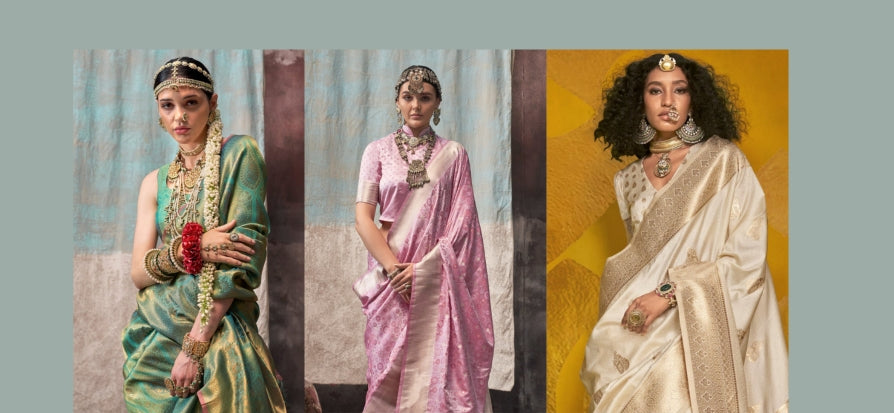
From Loom to You – How MySilkLove Sources Directly from India’s Weavers
Every saree on MySilkLove begins its journey not in a warehouse or a wholesale market, but at a loom — in a weaver's home, in a cluster where the craft has been passed down across generations. Understanding how MySilkLove sources its sarees is the story of why authenticity, price, and quality come together differently here than at most online saree retailers.
The Weaving Clusters MySilkLove Sources From
MySilkLove works directly with weaving clusters across India, building relationships with weavers and co-operative societies rather than sourcing through intermediary traders. Here are the primary clusters we work with:
Kanchipuram, Tamil Nadu — Kanjivaram Silk
Kanchipuram is the global home of the Kanjivaram saree, and MySilkLove sources directly from weaver families and cooperative societies in the town. The Kanjivaram's defining characteristics — the korvai border join, pure mulberry silk body, and real zari — can only be verified by someone who knows the cluster and the weavers personally. Our sourcing team visits Kanchipuram regularly to select sarees and verify GI certification at the source. Explore our Kanjivaram sarees.

Varanasi, Uttar Pradesh — Banarasi Silk
The mohallas of Varanasi — Madanpura, Alaipura, Peeli Kothi — are where master weavers produce Banarasi silk, organza, and georgette sarees that have defined Indian bridal fashion for centuries. MySilkLove sources directly from karigars and small weaving units in these neighbourhoods, ensuring that the brocade and meenakari work you receive has been created on handlooms, not jacquard machines. Browse Banarasi sarees.

Paithan, Aurangabad, Maharashtra — Paithani
Paithan is a small town with an outsized place in India's textile heritage — the Paithani saree woven here is recognised with a GI tag and is one of India's most technically demanding weaves. MySilkLove sources Paithani from both the traditional Paithan weavers and from Yeola, the secondary cluster that produces a range of handwoven and semi-handloom Paithani, ensuring we can offer the full spectrum from entry-level to heirloom.

Bhagalpur, Bihar — Tussar Silk
Bhagalpur is India's Silk City, and the source of the country's finest tussar (wild silk) fabric. Unlike mulberry silk, tussar is harvested from silkworms that feed on arjun and sal trees, producing a naturally textured, warm-toned fabric with an earthy lustre that mulberry silk cannot replicate. MySilkLove works with Bhagalpur weavers to source authentic tussar sarees with natural dyes and traditional motifs.

Kutch, Gujarat — Bandhani
Kutch is the heartland of Indian resist-dyeing crafts, and Bandhani tie-dye is its most celebrated textile tradition. Craftswomen in Bhuj and the surrounding villages tie thousands of tiny points in the fabric before dyeing, creating the characteristic dotted patterns that range from simple geometric to elaborate figurative compositions. MySilkLove sources Bandhani directly from Kutchi craft families, supporting both the silk Bandhani saree tradition and the cotton variants.
Why Direct Sourcing Matters for Price
The traditional saree supply chain typically looks like this: weaver sells to local trader → local trader sells to regional wholesaler → regional wholesaler sells to city distributor → city distributor sells to retail store → retail store sells to you. Each link in this chain adds a markup of 15–25%, meaning that by the time a saree reaches a retail showroom, it may carry a total markup of 40–60% above the weaver's price.
MySilkLove's model removes most of these intermediaries. We buy directly from weavers and cooperative societies, eliminating the local trader, regional wholesaler, and city distributor entirely. The result is that you pay closer to the real cost of the craft — and more of the money you spend reaches the weaver who made your saree. A Kanjivaram that would cost Rs 15,000 at a branded showroom in Chennai may be available on MySilkLove for Rs 9,000–11,000, not because quality has been compromised, but because the supply chain has been shortened.

How We Verify Authenticity
Authenticity in handloom sarees is not self-evident — it requires systematic verification at every stage:
- GI tag verification at source: For GI-registered weaves (Kanjivaram, Banarasi, Paithani, Sambalpuri, and others), we verify GI certification at the cluster level before purchase. We document the GI registration details and make them available to customers on request.
- Silk Mark checks: The Silk Mark Organisation of India certifies pure silk fabric. MySilkLove requests Silk Mark certification for all sarees sold as pure silk, and we pass this certification to the buyer with each saree.
- Weaver co-operative partnerships: Many of our sarees come directly from GI-registered weaver cooperative societies, which provide their own certification of origin and craft method. Cooperative tags are an additional layer of verification that is difficult to replicate.
- Quality control before dispatch: Every saree is individually inspected at our fulfilment centre before packing. We check for weaving defects, zari quality, fabric integrity, and accurate colour representation against the product photography. Sarees that do not meet our quality standard are returned to the supplier.

What You Get That You Do Not Get Elsewhere
Beyond price and authenticity, MySilkLove's direct sourcing model delivers value that is harder to quantify but deeply important:
- Direct artisan income: When you buy from MySilkLove, a greater share of your payment reaches the weaver. We are transparent about this as a core business principle, not a marketing claim.
- Accurate fabric descriptions: Because we know our suppliers personally, we can accurately describe what is in every saree — fabric composition, zari type, weave technique, region of origin. We do not call power-loom sarees "handloom-inspired" or list art silk as "silk blend." If something is power-loom or semi-handloom, we say so.
- No greenwashing: The handloom sector has seen a rise in brands that claim artisan credentials without verifiable sourcing. MySilkLove does not make craft claims we cannot substantiate. Every handloom claim on our site is backed by documented sourcing from verified weaving clusters.
- Continuity for the craft: By creating consistent demand for handwoven sarees at fair prices, MySilkLove contributes to keeping weaving as a viable livelihood for the next generation of artisans in India's heritage textile clusters.

FAQ
Are MySilkLove sarees handwoven?
Many are — but we are transparent when they are not. Our product listings clearly state whether a saree is handwoven, semi-handloom, or power-loom. We carry a range across all categories because we believe customers deserve accurate information to make the right choice for their budget and preference. All our handwoven sarees are sourced from verified weaving clusters, and we can provide sourcing documentation on request.
How do you ensure quality?
Quality control happens at two stages: at the weaver cluster level, where our sourcing team selects and inspects sarees before purchase, and at our fulfilment centre, where every saree is individually inspected before packing and dispatch. We also maintain return and exchange policies that allow customers to flag quality issues, and we use that feedback to continuously improve our sourcing standards.
Can I visit the weavers?
We are working towards facilitating weaver visits for customers who want a deeper connection with the craft. In the meantime, we regularly share weaver stories, loom videos, and cluster documentation on our social media channels so you can see the people and places behind your saree. If you are planning a trip to Kanchipuram, Varanasi, or Bhagalpur and would like a sourcing introduction, reach out to us directly.
Shop Directly from India's Weavers — browse our collections sourced from across India's finest handloom clusters: Kanjivaram sarees, Banarasi sarees, and our full handloom saree collection.

Shop Direct From the Loom
Buy the weaves above straight from the clusters we source them in — a shorter supply chain that puts more of your spend in the weaver's hands. Start with our cluster-sourced Kanjivaram silk sarees from Kanchipuram or the handloom Banarasi silk sarees from Varanasi, then browse the full handloom sarees collection — every piece documented to a verified weaving cluster and sortable by price.

Leave a comment
This site is protected by hCaptcha and the hCaptcha Privacy Policy and Terms of Service apply.