
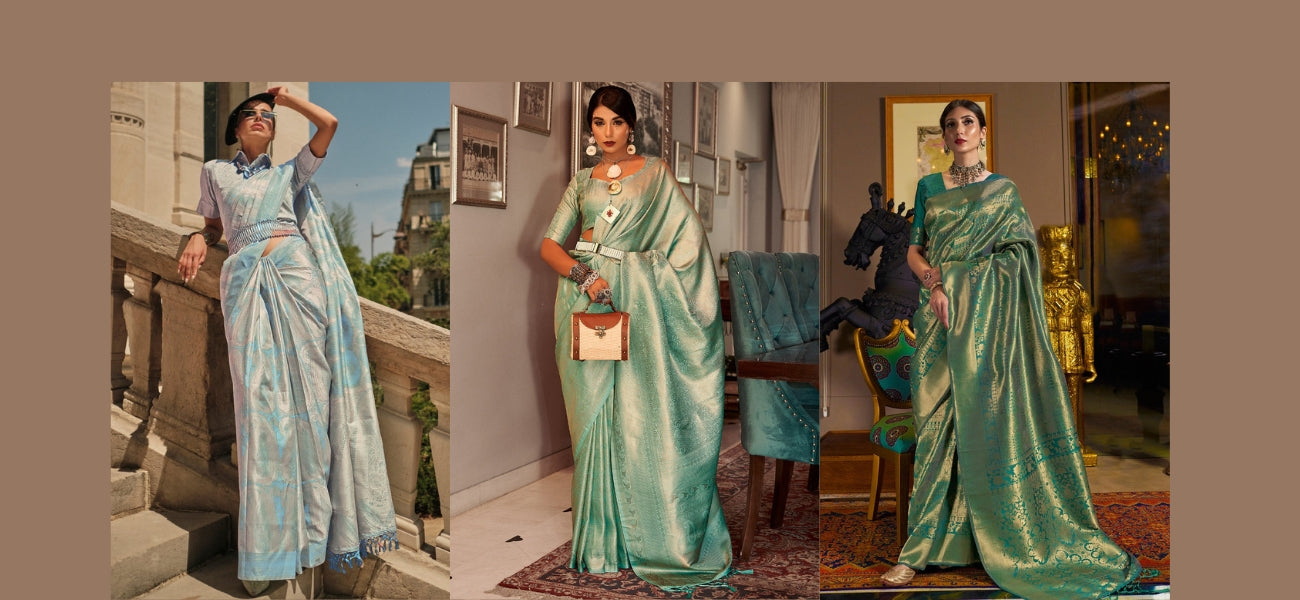
How to Identify a Genuine Kanjivaram Saree: 7 Tests + What to Avoid (2026)
Kanjivaram is the most counterfeited saree in India — here's how to tell the real from the fake. If you're ready to shop, browse our Kanjivaram sarees collection — 360+ pure mulberry silk styles. This guide helps you know what to look for before you buy.
What Makes a Genuine Kanjivaram Saree?
The word Kanjivaram is not just a place name — it describes a precise weaving tradition with three defining characteristics that no imitation fully replicates.
Pure Mulberry Silk
Genuine Kanjivaram sarees use only mulberry silk (Bombyx mori) sourced primarily from Karnataka. The silk threads are thicker and more tightly twisted than those used in lighter silks such as Mysore or Dharmavaram, which gives Kanjivaram its distinctive body and rustle. A high-quality saree typically uses 100-thread-count silk in the main body, contributing to the fabric's signature heft — around 700 to 900 grams for a six-metre saree.
The Korvai Technique
The most important authenticity marker is the korvai weaving method. In a genuine Kanjivaram, the body and the border are woven separately on two different sets of warp threads, then interlocked during weaving — not stitched or glued together after the fact. Run your finger along the inner edge where the border meets the body: you will feel a distinct ridge or interlocking line. On a fake, the border is usually a printed or woven-in stripe on a single continuous warp, and there is no tactile boundary. The korvai technique requires a second weaver and adds significantly to production time, which is one reason authentic pieces start at Rs 8,000 and can exceed Rs 2,00,000.

Temple Borders and Traditional Motifs
Traditional Kanjivaram borders feature gopuram (temple tower) motifs, rudraksham (rudraksha bead patterns), checks, and peacock or swan figures woven in contrast-coloured zari. The pallu — the decorative end piece — typically carries large buttas (motif clusters), lion or elephant designs, or elaborate floral grids. Authentic zari is made from a silver wire coated with real gold, giving it a warm, deep lustre. Cheaper pieces use copper-core zari coated with gold-coloured lacquer, which appears brighter initially but tarnishes rapidly and lacks the structural integrity of real zari.
7 Ways to Verify Authenticity at Home
1. The Burn Test
Pull a few loose threads from an inconspicuous hem area. Burn them with a lighter. Pure silk burns slowly, smells like burnt hair (keratin), and leaves a crushable ash that crumbles to powder. Synthetic fibres melt, produce black smoke, smell of burnt plastic, and leave a hard bead of residue that does not crumble. This test is definitive for fibre type, but do ask the seller's permission first or save any loose threads that fall during handling.
2. The Weight Test
A genuine six-metre Kanjivaram saree in heavy silk weighs between 700 grams and 950 grams — sometimes more for heavily zari-worked pieces. Lift the folded saree in your hands. If it feels surprisingly light, almost like georgette or chiffon, the silk content is likely blended or absent. You can use a kitchen scale at home if you purchase online and want to verify before washing. A significantly underweight piece — say, 400 grams — is almost certainly not pure silk.
3. Korvai Border Inspection
Unfold the saree and locate the inner edge where the border meets the body of the fabric. In a genuine Kanjivaram, you will see a thin, neat interlocking line — the junction where the two separate warp threads were joined during weaving. Hold the border up to the light: the weave structure at this junction is different from both the border and the body. On imitations, the border transitions smoothly because it is part of a single continuous warp, or the border is machine-stitched onto a plain body.
4. The Zari Scratch Test
Gently scratch a small area of the zari border with your fingernail. Real silver-core zari will show a bright silver line beneath the gold surface — the gold coating is thin, and the silver base is visible when disturbed. Copper-core imitation zari will reveal a reddish-orange copper tone beneath. This is one of the most reliable field tests you can do without damaging the saree. Authentic zari does not oxidise quickly and retains its lustre for decades when stored properly.

5. The Reverse-Side Check
Turn the saree over and examine the reverse of the pallu and border. In genuine handloom Kanjivaram, the reverse shows the floating threads of the design — you can see the rough, looped underside of the woven motifs. The zari threads on the back will be visible but not as prominent as the front. Power-loom imitations often have a much cleaner, more uniform reverse because the machine controls thread tension precisely; paradoxically, a slightly irregular reverse is a mark of authentic handloom work.
6. The Price Reality Check
Authentic Kanjivaram sarees cannot be produced below a certain cost threshold. Entry-level genuine pieces with minimal zari work start at around Rs 6,000 to Rs 8,000. Mid-range sarees with good zari borders and traditional motifs are typically Rs 12,000 to Rs 35,000. Heavily zari-worked bridal pieces range from Rs 40,000 to Rs 2,00,000 or beyond for masterwork pieces. If someone is offering a pure Kanjivaram for Rs 1,500 to Rs 3,000, it is not genuine — the silk yarn alone costs more than that wholesale.
7. Silk Mark Certification
The Silk Mark Organisation of India (SMOI) issues a holographic tag that certifies pure silk content. Ask to see the Silk Mark label — it should be attached to the saree and bear a hologram that cannot be easily replicated. The label includes a QR code or serial number verifiable on the SMOI website. Note that Silk Mark certifies fibre purity but not necessarily the handloom weaving method, so always combine this check with the korvai inspection and burn test for full confidence.
How to Choose by Occasion
Bridal Kanjivaram
For a bride, the Kanjivaram saree is often the centrepiece of the trousseau and the most photographed garment she will ever wear. Choose heavyweight silk (800 grams and above) with an elaborate pallu featuring temple or peacock motifs worked in real gold zari. Deep colours — bridal red, maroon, deep green, or royal purple — with contrasting borders in gold or silver are traditional and photograph beautifully. Avoid overly trendy colour combinations for a bridal piece; classic colour-contrast borders like red with green, or green with deep maroon, have remained timeless across generations. Budget: Rs 40,000 to Rs 2,00,000 and above. Always buy from a trusted weaver or certified silk house, and inspect the korvai personally before purchase.
Wedding Guest
As a wedding guest, you want impact without competing with the bridal party. Medium-weight Kanjivaram (600 to 750 grams) in rich jewel tones — peacock blue, deep teal, wine, or mustard — with moderate zari borders strikes the right balance. Semi-bridal pieces with broad borders but lighter body work well for day ceremonies; for evening receptions, choose a saree with a more elaborate pallu. Budget: Rs 10,000 to Rs 35,000 covers a wide range of beautiful, occasion-appropriate choices. Pair with gold jewellery and a contrast blouse cut from the border fabric.

Festival and Puja
For festivals like Diwali, Pongal, Navratri, or daily puja occasions, lighter-weight Kanjivaram (500 to 650 grams) with minimal or medium zari is practical and elegant. Colours like turmeric yellow, temple red, peacock green, and saffron are traditionally auspicious and widely worn. You can find beautiful festival-appropriate Kanjivaram pieces in the Rs 6,000 to Rs 15,000 range — these are the sarees you will reach for year after year and that actually improve with wear as the silk softens. Choose simpler motifs like small buttas and clean borders for a piece that transitions easily from morning prayers to afternoon gatherings.
What to Avoid When Buying Kanjivaram
The market for silk sarees includes significant volumes of imitation and misrepresented goods. Here are five specific red flags to watch for:
- Synthetic zari marketed as real gold zari: If the zari looks unnaturally bright, almost fluorescent gold, it is almost certainly copper-core or aluminium-core synthetic zari. Real gold-coated silver zari has a deep, warm, slightly muted lustre. Synthetic zari also wrinkles and kinks easily if you gently fold a small section of the border.
- Polyester-silk blends sold as pure silk: A common adulteration is to use a polyester warp with a silk weft, or vice versa. The fabric feels slightly different — less of the characteristic scroop (the rustling sound pure silk makes when rubbed) and a slightly plastic-like drape. The burn test distinguishes this immediately.
- Power-loom fabric marketed as handloom: Power-loom Kanjivaram-style sarees are not inherently inferior products, but they should not be sold as handloom. Tell-tale signs: perfectly uniform weave with no variation in thread density, extremely clean reverse side, and pricing that is too consistent across a large inventory. Genuine handloom pieces show small variations — a thread slightly thicker here, a motif slightly offset there — that are the fingerprints of human craft.
- Dharmavaram or art silk marketed as Kanjivaram: Dharmavaram sarees from Andhra Pradesh use a similar heavy silk style but are distinct in construction and do not use the korvai technique. Art silk (artificial silk, usually rayon or viscose) mimics the drape of silk but has none of its durability or lustre. If a seller cannot clearly explain the weaving technique and origin, treat the claim with scepticism.
- Poorly finished borders on bridal pieces: A genuine bridal Kanjivaram will have impeccable finishing — clean edges, tightly twisted thread ends, and a pallu that lies flat without puckering. Rushed or machine-finished pieces often show loose thread ends on the border, uneven zari tension that causes the border to ripple, or a pallu that curls at the edges. These are signs of compromised quality regardless of what the seller claims about the silk content.

Care and Storage
Dry cleaning vs hand washing: Heavily zari-worked Kanjivaram sarees should always be dry cleaned. The zari thread has a twisted metal component that can unravel with water immersion, and strong detergents will tarnish the coating. Lighter silk pieces with minimal zari can be gently hand washed in cold water with a small amount of mild shampoo — never agitate or wring. Lay flat to dry in shade; never hang a wet silk saree, as the weight of the water will distort the weave.
Muslin storage: Never store a Kanjivaram in a plastic bag or polythene cover. The trapped humidity accelerates oxidation of the zari and can lead to mildew on the silk. Wrap each saree individually in a clean white muslin cloth. The muslin breathes, protects against dust, and prevents colour transfer between sarees stored in the same stack.
Avoiding direct sunlight: Silk is a protein fibre that degrades rapidly under UV exposure. Even a few hours of direct sunlight will cause the colours to fade and weaken the threads. If you air your sarees — which you should do every six to eight weeks — do so in indirect light or in a well-ventilated indoor space, not on a clothesline in sunshine.
Airing and re-folding: Air your stored sarees every six to eight weeks. When you re-fold them, change the fold lines — always folding at a different point than the last time. Permanent crease lines can weaken silk threads over years of storage. Some collectors interleave their folded sarees with acid-free tissue paper, which is particularly good for pieces with raised zari motifs that might otherwise flatten under pressure.

Frequently Asked Questions
How do I identify a genuine Kanjivaram saree?
The three most reliable methods are: the korvai border check (feel for the interlocking ridge where the border meets the body), the zari scratch test (silver beneath the gold means real zari; copper means synthetic), and the burn test (pure silk burns like hair, not plastic). Combine these with checking for the Silk Mark certification label and verifying that the price is realistic for handloom silk. No single test is foolproof, but three concordant results give you high confidence.
What is a realistic price range for Kanjivaram sarees?
Entry-level genuine pieces with simple zari borders start at Rs 6,000 to Rs 8,000. Festival and everyday Kanjivaram sarees with medium zari work typically range from Rs 10,000 to Rs 25,000. Wedding and semi-bridal pieces with elaborate borders and pallus are Rs 25,000 to Rs 60,000. Full bridal masterwork pieces — heavily zari-worked, double warp, intricate temple pallu — range from Rs 60,000 to Rs 2,00,000 and above. Anything significantly below the entry-level price for the described quality level is almost certainly not a genuine handloom Kanjivaram.
Which occasions are Kanjivaram sarees best suited for?
Kanjivaram sarees are the default choice for South Indian weddings — both for brides and for wedding guests. They are equally at home at North Indian weddings, where their weight and lustre make a strong impression. Beyond weddings, they are worn for temple festivals, Pongal, Diwali, engagement ceremonies, baby showers (seemantham), and any formal occasion where silk is expected. Lighter Kanjivaram pieces are also worn as statement sarees for corporate events and cultural programmes. The versatility of the fabric — its ability to be dressed up or relatively down — is one reason Kanjivaram remains one of the most enduring silk traditions in India.
How should I care for my Kanjivaram saree?
Dry clean heavily zari-worked pieces. For lighter pieces, hand wash in cold water with mild shampoo, lay flat to dry in shade, and never wring. Store wrapped in white muslin — never plastic — and air the saree every six to eight weeks, changing the fold lines each time to prevent permanent creases. Keep out of direct sunlight. Iron on a low-heat silk setting with a pressing cloth between the iron and the fabric; never iron directly over zari borders. With this care, a quality Kanjivaram will remain wearable for decades.
What is the difference between Kanjivaram and Mysore silk?
Both are pure mulberry silk sarees, but they differ significantly in construction and character. Kanjivaram uses a thicker, tightly twisted silk thread, resulting in a heavier, stiffer drape. The korvai technique means the border is woven separately and interlocked. Mysore silk uses finer, softer threads, producing a lighter, more fluid drape. Mysore silk typically has less elaborate zari work and lighter borders. Kanjivaram is the formal, occasion-wear choice; Mysore silk is more comfortable for daily or semi-formal wear. Price points overlap, but the heaviest Kanjivaram pieces have no Mysore equivalent.

Where to Shop, and What Each Budget Actually Buys
The Kanjivaram collection is linked at the top of this guide. One honest note before you browse: at its bestselling end the regular list prices run from ₹4,332 to ₹5,347, below the Rs 6,000 to Rs 8,000 entry point test 6 gives. A few narrower routes:
- If hand-weaving is the thing you care about, our handloom sarees page is built from the handloom tag and only lists pieces with stock on hand; a Kanjivaram handloom sits among Banarasi handlooms at its bestselling end.
- For the gold tones this guide's zari and temple-border sections dwell on, our golden sarees page is built from the gold colour tag, only lists pieces with stock on hand, and is led by a gold-and-off-white Kanjivaram.
- The wedding-guest section suggests a more elaborate pallu for evening receptions; our reception sarees page is gated on stock the same way and has Kanjivarams near its bestselling end.
- For the lighter, softer-falling silks this guide compares Kanjivaram against in the FAQ, see soft silk sarees. We do not run a Mysore silk shelf.

Leave a comment
This site is protected by hCaptcha and the hCaptcha Privacy Policy and Terms of Service apply.