
Golden Saree: How to Tell Real Zari from Fake, and Which Fabric for Which Occasion
Real zari or fake? Heavy Kanjivaram silk or lightweight tissue? Knowing what you are looking at determines whether your golden saree lasts decades or tarnishes within a season. Ready to shop? Browse our golden sarees collection — 230+ zari and gold silk styles. This guide helps you understand what you're buying.
What Makes a Saree Truly Golden
Not all golden sarees are the same. The type of gold effect determines the drape, weight, durability, and occasion fit of the piece. There are three distinct categories:
Zari Brocade on a Coloured Base
This is the traditional category — a saree in a rich base colour (red, green, navy, maroon) with gold zari woven into the body, border, and pallu. The most prestigious versions are Kanjivaram silk with korvai borders and a heavily worked pallu, or Banarasi silk with intricate jaal (net) or butti (motif) brocade in gold zari. The gold here is not the base fabric — it is the ornamental thread worked through it. These are the most durable and formal of all golden sarees; a well-made piece retains its lustre for generations. Price range: Rs 8,000 to Rs 2,00,000 depending on silk type and zari density.

Gold-Tone Silk Base: Tissue and Banarasi Satin
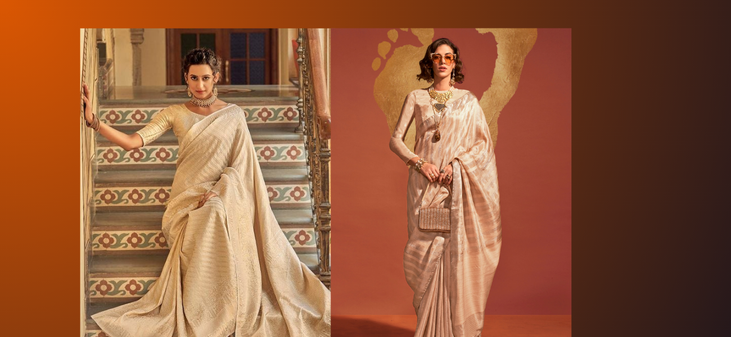
These sarees use a golden or champagne-coloured silk as the base fabric itself, so the entire saree glows. Tissue sarees are woven with a zari weft that gives the fabric a semi-transparent, luminous quality — they catch light dramatically and are popular for evening events and sangeet functions. Banarasi satin-weave silks in gold tone have a smooth, liquid drape with a subtle sheen. Both types are lighter than traditional Kanjivaram but equally glamorous. Price range: Rs 4,000 to Rs 40,000.

Metallic Print on Georgette or Organza
At the contemporary end of the spectrum, gold metallic prints on georgette or organza give a golden effect without the weight of silk or real zari. These are excellent choices for destination weddings, summer events, or occasions where you need to wear a saree comfortably for long hours. The gold effect comes from foil printing or metallic ink rather than woven metal, so the drape is fluid and the fabric breathable. Price range: Rs 1,500 to Rs 8,000. These are not investment pieces — they are stylish, wearable, and practical for frequent use.
Best Golden Sarees by Occasion
Bridal
For a bride choosing a golden saree, the Kanjivaram gold-on-red or gold-on-green is the classic South Indian choice — heavily zari-worked, with a temple pallu and korvai border in bright gold. For a North Indian bride, a Banarasi silk in deep red with gold jaal brocade or an all-gold tissue Banarasi with contrast border is equally regal. The key for bridal wear is real zari content and silk weight: the saree must drape with authority and photograph with depth. Avoid light or thin fabrics for a bridal piece — they do not carry the visual weight the occasion demands. Budget: Rs 40,000 to Rs 2,00,000 and above for a true bridal piece.

Festive
Festivals like Diwali, Pongal, Navratri, and Onam call for festive gold without full bridal formality. A medium-weight Kanjivaram with a gold border and buttas on a jewel-toned base — peacock blue, emerald green, or deep maroon — is perfect. Alternatively, a Banarasi georgette or semi-silk with gold motifs gives you festive impact with much less weight, ideal for long festival days. Budget: Rs 5,000 to Rs 25,000 covers excellent festive options across both categories.
Sangeet and Pre-Wedding Events
Sangeet functions are where you can be more experimental. An all-gold tissue silk saree with a contrast border, or a gold organza with embellished blouse, hits the right note — glamorous and photogenic but distinct from the bridal look. Gold with a pop of colour in the border (fuchsia, electric blue, emerald) works particularly well for sangeet. You want something that moves and catches light on the dance floor. Budget: Rs 6,000 to Rs 35,000 depending on silk vs. fabric choice.

Office Festive
For office Diwali parties or corporate festive events, a gold-tone saree needs to be comfortable and not too heavy. Lightweight Banarasi georgette in champagne or pale gold, or a printed organza with subtle gold motifs, strikes the right balance between festive and professional. Avoid very heavily zari-worked pieces for office settings — they read as too formal. Budget: Rs 2,000 to Rs 10,000 for practical, wearable, and elegant office-festive options.
Gold Depth and Skin Tone Guide
Gold is not one colour — it ranges from cool champagne to deep antique amber, and the right shade of gold depends significantly on your skin tone.
Warm gold (yellow-gold, bright zari gold): Works beautifully on medium, wheatish, and dark skin tones, where the contrast between the gold and skin creates a luminous, glowing effect. Bright gold zari on dark skin is one of the most striking combinations in Indian fashion. On very fair skin, warm bright gold can appear overwhelming — balance it with a jewel-tone base colour.
Cool gold / champagne gold (pale gold, silver-gold): Flatters fair and light-medium skin tones. Champagne tissue sarees and pale gold organza look ethereal on fair skin without the harsh contrast of bright yellow-gold. On darker skin tones, cool champagne gold can appear muted — the contrast with the skin is lower and the effect less dramatic.
Antique gold (oxidised, burnished, bronze-gold): The most versatile of the three — antique gold works across all skin tones. It has warmth without brightness, and the slightly muted, burnished quality adds depth and sophistication. Antique gold zari in Banarasi or Kanjivaram sarees is particularly beautiful and tends to age gracefully, gaining character rather than looking dated. On wheatish and medium skin tones, antique gold is especially flattering.

How to Tell Real Zari from Fake
The golden saree market has several traps that can leave you with a disappointing, short-lived purchase. Here are five specific red flags and how to spot each one:
- Synthetic zari that tarnishes within a season: Copper-core synthetic zari looks attractively bright in the shop but oxidises to a greenish-brown within one to two seasons, especially if exposed to moisture. How to spot it: scratch a small zari thread with your fingernail — real silver-core zari shows silver beneath the gold; copper-core zari shows reddish copper. Synthetic zari also bends and kinks more easily than real zari when you fold the border gently.
- Cheap tissue fabric that disintegrates: Some low-quality tissue sarees use extremely fine synthetic threads in the weft that create the shimmer effect but have no durability. The fabric tears along fold lines after a few wears and shreds at the edges. How to spot it: hold the fabric up to light and look at the weave structure — quality tissue has a visible, regular warp-and-weft; cheap tissue looks like a film with shimmer particles rather than a woven fabric.
- Gold-printed polyester sold as silk: Polyester with a gold foil print is commonly misrepresented as tissue silk or Banarasi. The drape is fundamentally different — polyester has a stiffer, slightly plasticky fall, while silk flows and clings. The burn test is definitive: polyester melts and smells of burning plastic; silk burns like hair. Also check the price — genuine Banarasi tissue silk below Rs 4,000 is virtually non-existent.
- Single-warp borders passed off as korvai: On Kanjivaram-style golden sarees, sellers sometimes describe machine-woven borders as korvai work. Run your finger along the inner border edge — a genuine korvai border has a tactile interlocking ridge where two separate warps were joined. A machine-woven single-warp border feels smooth and uniform with no structural junction.
- Heavily starched fabric disguising poor quality: Some vendors starch fabric heavily to give it a heavier, stiffer feel that mimics quality silk. The starch washes or steams out after the first wear, leaving you with a limp, thin fabric that bears no resemblance to what you saw in the shop. If a fabric feels rigidly stiff with an almost cardboard-like quality, ask to see an unwashed sample or buy from a seller who allows returns.

Blouse Pairings
The blouse can make or break a golden saree look. Here are four specific combinations that work across different golden saree types:
Jewel-tone contrast blouse: A deep emerald, sapphire blue, or ruby red blouse with a gold saree creates a high-contrast, jewellery-like effect that photographs beautifully. This pairing works especially well with Kanjivaram gold-zari sarees on a coloured base. Match the blouse tone to the saree base, or pick the contrast colour from the saree border.
Matching gold blouse: A blouse in the same gold fabric — especially for tissue or Banarasi sarees — creates a seamless, monochromatic look that reads as very polished and modern. Add contrast through jewellery — a deep coloured necklace or statement earrings — rather than the blouse. This combination suits corporate events and daytime festive occasions well.
Black blouse: Black with gold is a perennial, never-fail combination. A plain black silk or crepe blouse grounds the gold saree and gives a contemporary edge without distracting from the fabric. Particularly effective for evening events, reception functions, and corporate parties. Avoid black with traditional bridal gold — it reads as too modern for ceremony wear.
Velvet blouse: A deep velvet blouse in burgundy, forest green, or midnight blue paired with a heavy gold Kanjivaram or Banarasi gives a wintertime festive look that is both luxurious and warm. Velvet blouses add texture contrast to the smooth silk drape and look particularly good at indoor evening events. This combination works for Diwali parties and engagement ceremonies during cooler months.

Zari Care and Storage
How to store zari pieces: Never fold a heavily zari-worked saree tightly on itself — the metal threads in the zari can crack or lose their coating at sharp fold lines over time. Instead, roll the saree around a cotton muslin tube or fold it loosely with multiple soft fold points. Always wrap the saree in clean white muslin cloth, never plastic. Plastic traps moisture and accelerates the oxidation process that turns gold zari dull.
Muslin wrap technique: Lay the saree flat, place a sheet of muslin over it, and roll both together. Store horizontally if possible rather than vertically. If you must store vertically in a wardrobe, ensure the saree is not compressed under other garments — pressure flattens raised zari motifs permanently.
Air drying and airing: Never dry a golden saree in direct sunlight. Sunlight both fades the silk base colour and degrades the lacquer coating on zari threads, accelerating tarnishing. Dry in shade or indoors with good air circulation. Air your stored sarees every six to eight weeks — take them out, let them breathe for a few hours in a well-ventilated room, then re-wrap and re-store with different fold lines.
Keeping zari from oxidising: Zari oxidises in the presence of moisture, sulphur (from perfumes and hairsprays), and air pollution. Store a small piece of camphor or silica gel desiccant near your silk sarees — not touching the fabric directly — to control humidity. Never spray perfume directly on a zari saree; apply fragrance to your skin first and let it dry before draping. After wearing, do not fold and put away immediately — air the saree for at least an hour before storing.

Frequently Asked Questions
Which fabric is best for a golden saree?
It depends on the occasion and your comfort preference. For formal ceremonies and weddings, heavy Kanjivaram silk or Banarasi silk with real zari is the gold standard — they drape with authority and last for decades. For festive events where you will be on your feet for hours, a semi-silk or Banarasi georgette in gold tone balances glamour with wearability. For contemporary or casual festive occasions, gold organza or georgette with metallic print gives you a modern look at a fraction of the weight.
What is the price of a Kanjivaram gold saree?
A genuine Kanjivaram saree with gold zari borders and a worked pallu starts at around Rs 8,000 for entry-level pieces with minimal zari. Mid-range pieces with broad korvai borders and traditional motifs are typically Rs 15,000 to Rs 40,000. Heavily zari-worked pieces suitable for bridal wear are Rs 40,000 to Rs 1,50,000. Masterwork pieces with full-body zari, double-warp construction, and antique gold thread can exceed Rs 2,00,000. The price reflects the weight of the silk, the density of the zari, and the complexity of the weave — all of which you can verify before buying.
Which gold saree suits my skin tone?
Fair skin tones: go for cool champagne gold or pale antique gold; bright yellow-gold can overwhelm. Medium skin tones: most gold shades work — bright gold zari and antique gold both flatter; match the base colour of the saree to your preference. Wheatish skin tones: antique gold and warm yellow-gold are both flattering; contrast the base colour for maximum impact. Dark skin tones: bright yellow-gold zari is strikingly beautiful on darker skin; the higher contrast creates a luminous, rich effect. Avoid pale champagne on dark skin — the low contrast reduces the visual impact.
How do I store a golden saree?
Wrap in clean white muslin — never plastic. Store horizontally or loosely folded with multiple fold points; avoid tight single-fold lines along the zari borders. Keep near a silica gel packet or small camphor block to control humidity. Air every six to eight weeks and change fold lines each time. Keep away from direct sunlight, perfumes, and hairsprays. Do not compress under other garments. With this care, a quality zari saree will retain its lustre for twenty years or more.
How do I tell real zari from fake zari?
The most reliable test is the scratch test: gently scratch a zari thread with your fingernail. Real silver-core zari (even with a gold coating) reveals a bright silver colour when the surface is disturbed. Copper-core synthetic zari reveals a reddish-orange copper colour. Real zari also bends and drapes with the fabric — it does not stiffen or kink the border. Fake zari often makes the border feel stiffer than the body of the saree. Real zari has a warm, slightly muted lustre; fake zari tends to look unnaturally bright or slightly plasticky in strong light.

Shop Golden Sarees by Type
Now that you know what to look for, shop the category that matches your occasion:
- Browse the full golden sarees collection — the page is inventory-gated, so every piece shown has stock on hand.
- For the gold-zari-brocade-on-a-coloured-base category described above, shop Kanjivaram silk sarees with woven borders and worked pallus.
- For the gold-tone silk base — where the whole body glows rather than just the motifs — see our tissue sarees, woven with a metallic weft.
- If woven-in zari matters more to you than a metallic print, start with handloom sarees — loom-woven, so the metallic work is part of the cloth.


Leave a comment
This site is protected by hCaptcha and the hCaptcha Privacy Policy and Terms of Service apply.