
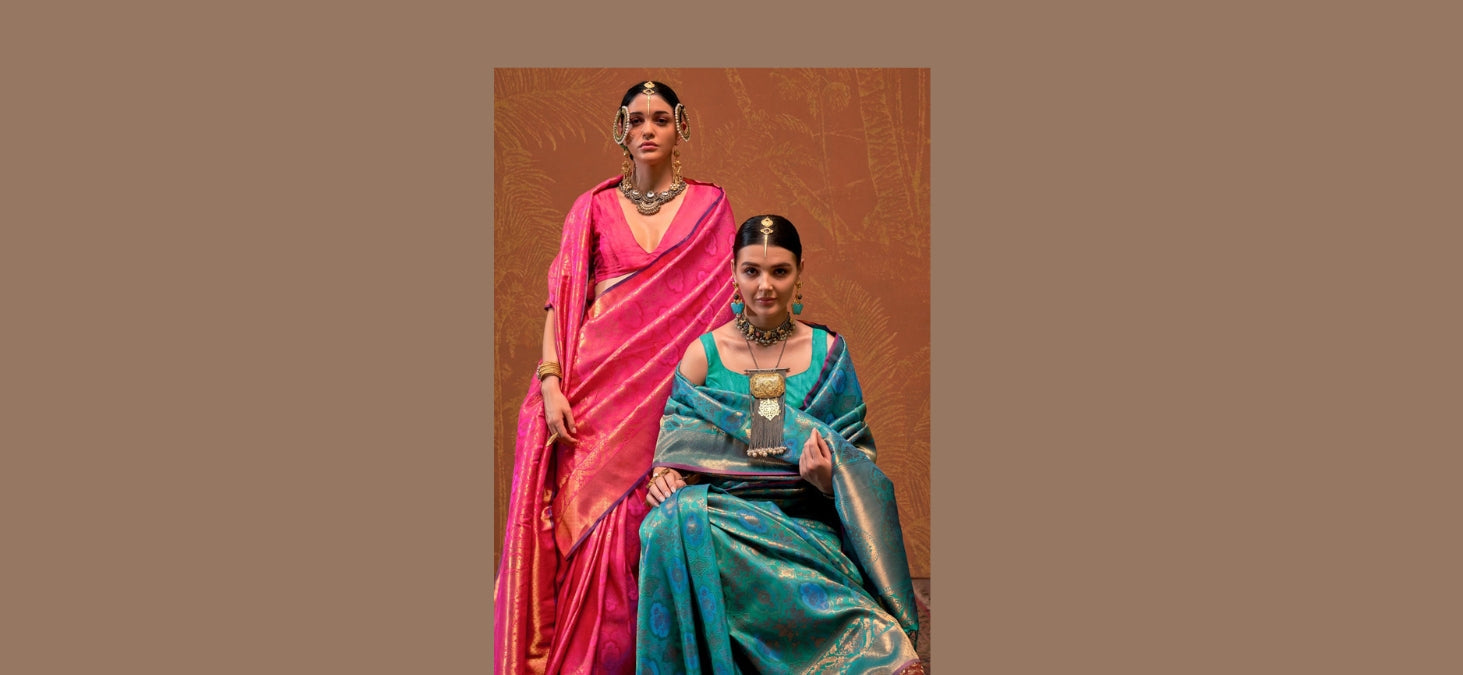
Kanjivaram vs Mysore Silk Saree – What Is Actually Different?
The Kanjivaram vs Mysore silk saree debate is one of the most common questions among South Indian silk buyers — and with good reason. If you've decided on Kanjivaram, browse our Kanjivaram sarees collection. If you're still comparing, read on. Both are prestigious South Indian silks, both carry deep cultural heritage, and both are worn at weddings and significant ceremonies. But they are fundamentally different in their weaving technique, visual character, weight, and occasion suitability. Choosing the right one requires understanding what sets them apart at the loom level, not just by appearance.
Origins and Heritage
Both silks trace their origins to Karnataka and Tamil Nadu's long tradition of royal patronage for handloom weaving, but their birthplaces give them distinct identities.
Kanjivaram (Kanchipuram Silk)
Kanjivaram silk originates from Kanchipuram, a temple city in Tamil Nadu approximately 75 km from Chennai. Weaving has been practiced there for over 400 years, traditionally by the Devangar and Mudaliar weaver communities who are said to have been brought to Kanchipuram by the Pallava kings. The craft is protected by a Geographical Indication (GI) tag, meaning only sarees woven in the Kanchipuram region using the traditional three-shuttle technique can legally be called Kanjivaram sarees. The GI was granted in 2005–06.
Mysore Silk
Mysore silk weaving was established and patronised by Hyder Ali and later Tipu Sultan, and subsequently developed by the Mysore Maharajas in the 18th and 19th centuries. The Government of Karnataka eventually took formal control of production through the Karnataka Silk Industries Corporation (KSIC), which remains a central supplier of authentic Mysore silk today. Mysore silk also holds a GI tag, granted in 2013, covering silk sarees produced in the Mysore region of Karnataka.

Weave Technique
The structural difference between these two silks is rooted in how they are set up on the loom — a difference that produces their distinct visual and tactile characteristics.
Kanjivaram: The Korvai Technique
Kanjivaram sarees use the korvai technique, which involves two separate warps — one for the body of the saree and one for the border. These two warps are interlocked at the joining point using a third shuttle carrying weft threads. This interlocking makes the Kanjivaram border structurally integrated with the body: you cannot separate the border from the body without unravelling the weave. The interlocking point is visible as a neat, woven seam rather than a sewn join. This technique also allows the border to be woven in a completely different colour from the body — the signature Kanjivaram contrast border.
Mysore: Single Warp, Softer Weave
Mysore silk is woven on a single continuous warp, with the border and body sharing the same warp threads. The border design is created by changing the weft colour and pattern — not by interlocking a separate warp. This produces a softer, more unified fabric structure with a fluid drape that is quite different from the firm body of a Kanjivaram. The result is a saree that feels lighter on the body and moves more freely, trading the dramatic visual weight of Kanjivaram for wearability.

Visual Differences
Side by side on a display, the two silks are recognisable even to a developing eye:
Kanjivaram
- Border: Bold, contrasting colour border — typically 4–6 inches wide — that differs dramatically from the body colour (classic combinations: red body with green border, blue body with gold border)
- Zari: Heavy, deep zari work throughout — in the border, the pallu, and often across the body in a jaal (lattice) or butta (motif) pattern
- Motifs: Temple motifs are the most iconic — gopuram (temple tower), rudraksham (rudraksha bead), annam (swan), mayil (peacock), and checks (muthu kattam, kavi kattam)
- Overall feel: Rich, heavy, ceremonial — a saree that commands attention in a room
Mysore Silk
- Border: Subtle, tonal or lightly contrasting border — often the same colour family as the body, with restrained zari edging
- Zari: Minimal and refined — used as accent rather than dominant feature; the silk body takes centre stage
- Motifs: Floral patterns, small paisley, and subtle geometric motifs in understated colours; the overall aesthetic is elegant rather than opulent
- Overall feel: Soft, luminous, sophisticated — a saree that rewards close inspection rather than announcing itself from across the room
Comparison Table
| Feature | Kanjivaram Silk | Mysore Silk |
|---|---|---|
| Weight (6m saree) | 700g – 1,000g+ | 400g – 650g |
| Zari content | Heavy — border, pallu, and body | Light to moderate — border and pallu accents |
| Border style | Bold contrast colour, 4–6 inches | Subtle, tonal, 1–3 inches |
| Primary occasions | Weddings, religious ceremonies, formal events | Weddings (guest), office formal, formal occasions |
| Price range | Rs 5,000 – Rs 25,000+ | Rs 3,000 – Rs 12,000 |
| Drape stiffness | Firm, holds pleats rigidly | Soft and fluid, pleats gently |
| GI tag region | Kanchipuram, Tamil Nadu | Mysore, Karnataka |
| Warp structure | Dual warp (korvai interlocking) | Single continuous warp |

Price Comparison
Both silks are premium products, but their price ranges reflect real differences in material costs and weaving complexity.
Kanjivaram: Rs 5,000 – Rs 25,000+
The higher price of Kanjivaram reflects several compounding factors: the korvai dual-warp technique requires a skilled weaver and more time per saree; zari content is substantially heavier (more gold or silver thread per square metre); pure mulberry silk threads of a specific twist count are required; and the saree typically weighs more, meaning more raw material per piece. Heritage pieces from established weaver families with documented provenance regularly exceed Rs 50,000.
Mysore Silk: Rs 3,000 – Rs 12,000
Mysore silk is less expensive not because of inferior craftsmanship but because the weave is structurally simpler (single warp), zari usage is lower, and the lighter weight means less silk per saree. The KSIC (Karnataka Silk Industries Corporation) produces certified Mysore silk sarees at accessible price points, and their certification provides strong authenticity assurance. Premium Mysore silk sarees with heavy zari pallus can approach Rs 12,000–15,000.
Care Instructions
Caring for Kanjivaram Silk
- Cleaning: Dry clean is strongly recommended for heavy Kanjivaram pieces with deep zari work. Home washing risks zari tarnishing and structural distortion of the korvai join.
- Storage: Store flat, folded in muslin cloth. Refold along different fold lines every few months to prevent permanent creases in the heavy silk body.
- Zari care: Exposure to perfume, deodorant, and sweat accelerates zari tarnishing. Wear a light cotton slip and apply fragrance before draping, never after.
- Long-term: Keep in a cool, dry space. Avoid plastic bags — silk needs to breathe. Use neem leaves or cedar blocks to deter insects without damaging zari.
Caring for Mysore Silk
- Cleaning: Lighter Mysore silk pieces (minimal zari) can tolerate gentle hand washing in cold water with a mild, silk-safe detergent. Do not wring — roll in a clean towel to remove excess water.
- Heavier pieces: Mysore silks with heavy pallu zari should be dry cleaned.
- Drying: Dry in shade — direct sunlight can bleach the rich colours of the silk body over time.
- Storage: Store folded in soft cotton cloth, away from moisture. The lighter weight of Mysore silk means it is less prone to permanent crease marks than Kanjivaram.

Which Should You Choose?
Use this decision framework to find your answer:
- If you want a bridal saree with maximum visual impact → choose Kanjivaram. The bold contrast border, heavy zari, and structural weight deliver the ceremonial presence a wedding demands.
- If you want an all-day silk saree you can wear comfortably for hours → choose Mysore silk. The lighter weight and fluid drape are significantly more comfortable over long events.
- If you want a silk saree for a formal office environment or semi-formal occasion → choose Mysore silk. Its restrained elegance reads sophisticated without being ceremonially heavy.
- If you want a saree that will be an heirloom passed down in the family → choose a certified Kanjivaram. The korvai weave, heavy silk, and real zari age beautifully over decades.
- If your budget is Rs 3,000–6,000 and you want authentic South Indian silk → choose Mysore silk. Genuine KSIC-certified pieces are available in this range; genuine Kanjivaram at this price is rare and warrants careful authentication.
- If you are buying as a gift and are unsure of the recipient's preference → Mysore silk is more versatile across occasions and is easier to drape and wear for less experienced saree wearers.

Frequently Asked Questions
How can I tell a genuine Kanjivaram from a fake?
The most reliable indicator is the korvai join: on a genuine Kanjivaram, look at the line where the border meets the body. You should see a neat, woven interlocking of threads — not a sewn or glued seam. The reverse of the saree will show floating zari threads between motifs. Also look for the Silk Mark tag and the GI tag with a verifiable QR code. Machine-made "Kanjivaram-style" sarees will have a stitched border join and a clean, uniform reverse.
Is Mysore silk also available with heavy zari work?
Yes. While Mysore silk is traditionally associated with a more restrained aesthetic, sarees with heavily zari-worked pallus and borders are produced for bridal and high-occasion markets. These pieces can approach Kanjivaram visual richness while retaining Mysore silk's characteristic softness and lighter weight. KSIC's bridal range is a reliable source for these.
Can I wear Kanjivaram to a non-wedding occasion?
Absolutely, though the visual weight means it suits formal and semi-formal occasions better than casual ones. Kanjivaram sarees are popular for temple visits, classical dance performances, graduation ceremonies, and high-end corporate events. Lighter Kanjivaram variants (thinner body, minimal zari) bridge the gap between ceremonial and semi-formal wear.
Which silk saree is more comfortable to drape for beginners?
Mysore silk is considerably easier to drape for beginners. The lighter weight and fluid structure are more forgiving of imprecise pleating, and the saree sits more easily on the shoulder without the constant adjustment that a heavy Kanjivaram sometimes requires. If you are new to silk sarees, Mysore silk is an excellent starting point before graduating to the weight of a full Kanjivaram.
Explore our handpicked collection of Kanjivaram sarees and browse our full silk saree collection — every piece sourced with verified authenticity and detailed fabric information so you can buy with confidence.

Shop the decision you just made
The Kanjivaram and silk saree shelves are already linked above, so this section routes the four choices the framework actually leaves you with. Budget Rs 3,000–6,000? The honest note first: MySilkLove does not stock a Mysore silk shelf, so the nearest match here is the Kanjivaram sarees under Rs 5,000 edit — and, as the section above says, run the korvai-join check on anything in that range rather than assuming it. Want the softness and fluid drape Mysore is prized for? Browse soft silk sarees, the lighter-bodied weaves that pleat gently in the same way. Want the handwoven loom itself, not a powerloom copy? Explore handloom sarees, which are tag-built and show only pieces with stock recorded against them. Buying for the wedding the framework's first row describes? See the Wedding Edit.

Leave a comment
This site is protected by hCaptcha and the hCaptcha Privacy Policy and Terms of Service apply.