
Korvai: The Two-Weaver Handshake Hidden Inside a Kanjivaram's Contrast Border
What makes a Kanjivaram's contrast border so special — and so expensive? The short answer is a word most saree shoppers have never heard: korvai. It is a hand-interlocking technique that needs two weavers, three shuttles and a great deal of patience, and it is the reason a true contrast-border Kanjivaram costs more than a plain one. Here is what it is, how to spot it, and a small confession from our own catalog.
Korvai means “joining”
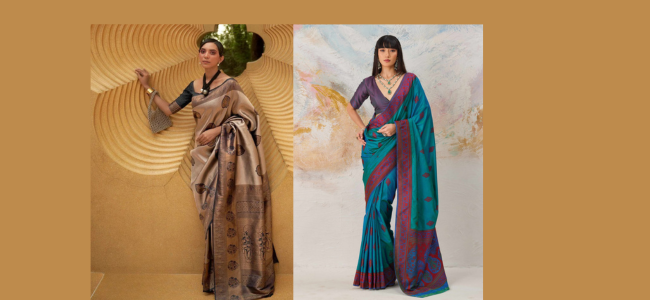
In Tamil, the word describes exactly what the technique does: it joins a saree's body to a border of a completely different colour, by hand, thread by thread, with no seam and no cut cloth. When you see a mustard Kanjivaram with a deep maroon border, or a peacock-blue body framed in magenta, you are almost always looking at korvai. The contrast is not printed, dyed over, or stitched on afterwards — the two colours are interlocked on the loom itself.

Why it takes two people and three shuttles
An ordinary saree is woven with a single weft shuttle carrying one colour across the loom. Korvai cannot work that way, because the body and the border are different colours that must meet in a clean, interlocked line. So the weave uses three shuttles — one for the body weft and two for the borders — and, traditionally, two weavers sitting on opposite weft edges of the same loom. One works the body; the other works the border and the pallu. Where the two colours meet, the weavers loop the contrasting wefts around each other by hand to interlock them. It is slow, finger-intensive work that no power loom replicates convincingly, which is precisely why korvai sarees cost more than plain silks and why the technique is treated as the crown of South Indian handloom.
How to spot real korvai in 20 seconds
Three quick checks anyone can do, in a shop or on a screen:
- Turn the border over. In genuine korvai the contrast colour is woven through to the reverse and the join looks clean and interlocked from both sides. A border that is one colour on the front and “ghosts” or smudges on the back is usually printed or a single-shuttle imitation.
- Look at the join line. Hand-interlocked korvai has a faint, slightly toothed line where body meets border — tiny interlocking loops, not a ruler-straight machine seam.
- Pull gently at the border (on your own saree). A korvai border is structurally locked into the body; it should not feel like a separate strip attached on top.

A confession from our own catalog
We sell Kanjivarams for a living, so we ran the numbers on our own listings on 16 June 2026. We carry 1,208 Kanjivaram-tagged sarees. The word “korvai” appears in zero of their titles. So does “contrast.” In other words, a technique that defines the look and explains a chunk of the price was — in our own shop window — completely unnamed. We doubt we're unusual; scroll any Kanjivaram listing online and you'll find colours, zari motifs and occasions described in loving detail, and the actual weaving technique almost never mentioned.
That matters for shoppers. If you can't see the word, you can't ask for the thing, and you can't tell whether the contrast border you're paying extra for is hand-interlocked korvai or a printed lookalike. The craft economy works better when the craft is named: weavers who do the harder, slower work deserve to have it labelled, and buyers deserve to know what the premium is for. We're fixing our own listings, and we'd rather the whole category did.

A small heritage you can wear
Korvai sits inside the larger story of Kanchipuram silk, which carries a Geographical Indication (GI No. 15) recognising the region's centuries-old weaving tradition. The GI protects the name; korvai is one of the living techniques behind it. When you next unfurl a contrast-border Kanjivaram, run your thumb along the join. That faint toothed line is two pairs of hands, three shuttles and a Tamil word for “joining” — woven into something you can drape.
Method & honesty note. Catalog figures are from MySilkLove's live Shopify catalog on 16 June 2026 (1,208 Kanjivaram-tagged listings, 145 currently active; 0 with “korvai”/“contrast” in the title). Technique here is inferred from contrast-border design, not a per-loom audit — and yes, that under-labelling includes us, which is rather the point. Reuse this data freely with a link back to this page.
See Korvai for Yourself
Now that you know what to look for, take the reverse-side test to our Kanjivaram sarees collection. As the confession above says, none of our listings names korvai in its title yet, so the join line is yours to check — the shelf is rule-built, and a saree only appears on it while stock is recorded against it. Shoppers who ask for the weave by its Tamil name will find the Kanjivaram-tagged pieces under pattu sarees. And because korvai is hand work by definition, the handloom sarees collection is where our hand-woven pieces are grouped; the Casal Blue Kanjivaram Handloom sits at its head.

Leave a comment
This site is protected by hCaptcha and the hCaptcha Privacy Policy and Terms of Service apply.