

Silk Sarees in Lucknow: Where to Buy Online (2026)
 If you are buying a saree in Lucknow, the real question is not which shop in Aminabad — it is chikankari or Banarasi. Uttar Pradesh holds the GI tag on both, and they solve completely different problems. Chikankari is what you wear through a Lucknow summer and to every daytime function; Banarasi is what you wear at the ceremony itself. Buy in that order and you will actually wear both. Buy it backwards, which most people do, and one of them sits in a cupboard for four years.
Why Lucknow is a two-weave city
Lucknow Chikankari received its Geographical Indication certification in 2009 — meaning only work produced in the Lucknow artisan belt can legally be sold as Lucknow Chikan. That belt is real and still working: Chowk for traditional karkhanas, Aminabad for volume, and the home-based clusters around Daliganj and Kakori where most of the actual needlework happens.
Varanasi sits about 300 km away and gives the same state its other famous GI product, the Banarasi. So an Awadhi wardrobe has always been split between the two: white-on-white needlework for the day, zari brocade for the night.

The 60-second chikankari test (do this before you pay)
Chikankari is not one stitch — traditionally around 32 are documented, though working artisans use a much smaller set. The names worth knowing when a seller starts talking:
- Bakhiya — the shadow work. Stitched on the reverse of the fabric so the motif shows through as a soft, filled shadow from the front. This is the signature stitch and the hardest to fake.
- Murri and phanda — tiny raised rice-grain and knot stitches used for flower centres. Murri is finer and costs more; phanda is rounder and quicker.
- Jaali — threads are teased apart to make a net, never cut. If you see cut holes, it is not jaali.
- Tepchi — a long running stitch used to outline and to fill cheaply. A saree that is mostly tepchi is an entry-level piece, and should be priced like one.
The test: turn the pallu over. On genuine hand chikankari the reverse is almost as tidy as the front — bakhiya in particular is designed to be read from the back. Machine chikan gives itself away instantly: long floating threads jumping between motifs, and a rhythm that is too perfect and too identical, motif to motif. Hand needlework has small, honest variation. That is the point of it.
What Lucknow weather actually demands
This is where a lot of online buying goes wrong. Lucknow does not have a mild year — it has three sharply different ones.
- April to June (40–44°C): mul mul cotton or fine cotton chikankari only. A handwoven mul mul saree lands somewhere around 350–450g. A Banarasi katan runs closer to 700–900g. You will feel that difference within an hour at an outdoor haldi, and you will feel it for the next five.
- July to September (humid monsoon): avoid heavy zari — damp air is exactly how zari tarnishes. Georgette and lighter chikankari grounds recover from humidity far better than a stiff brocade.
- December to January (down to 5–7°C): this is Banarasi season, and it is also why Lucknow winter weddings are the best-dressed ones. Silk holds warmth; a Chowk-style shawl over a brocade is a genuinely Lucknawi look, not a compromise.
One more local thing that never appears in generic guides: in many Awadhi families the pallu is drawn over the head at the nikah or the puja. That means pallu drape matters more than pallu weight — a stiff, heavily embellished pallu slides off. A softer chikankari or a fluid handloom silk stays put.

What you should actually pay
In the Lucknow market, heavy bridal chikankari can climb into the tens of thousands, and hand-embroidered pieces are genuinely priced by stitch count and hours — a densely worked bakhiya saree can take an artisan months. That is the market context.
What we stock sits in a narrower, more everyday band. Our Lucknowi chikankari sarees are listed at ₹5,595, the handwoven pure mul mul cotton chikankari at ₹5,925, and our handloom Banarasi silks in the ₹5,800–₹7,500 range. Those are regular list prices — seasonal offers at checkout often bring these lower. We are not a bridal-couture chikankari house, and it would be dishonest to imply otherwise; what we do well is the wearable middle of the market.
Shop the edit
- Rose Pink Woven Lucknowi Chikankari Saree — the softest of the lot; the one to wear to a daytime mehndi.
- Spun Pearl Grey Woven Lucknowi Chikankari Saree — tonal, not white-on-white, which reads far better in photographs.
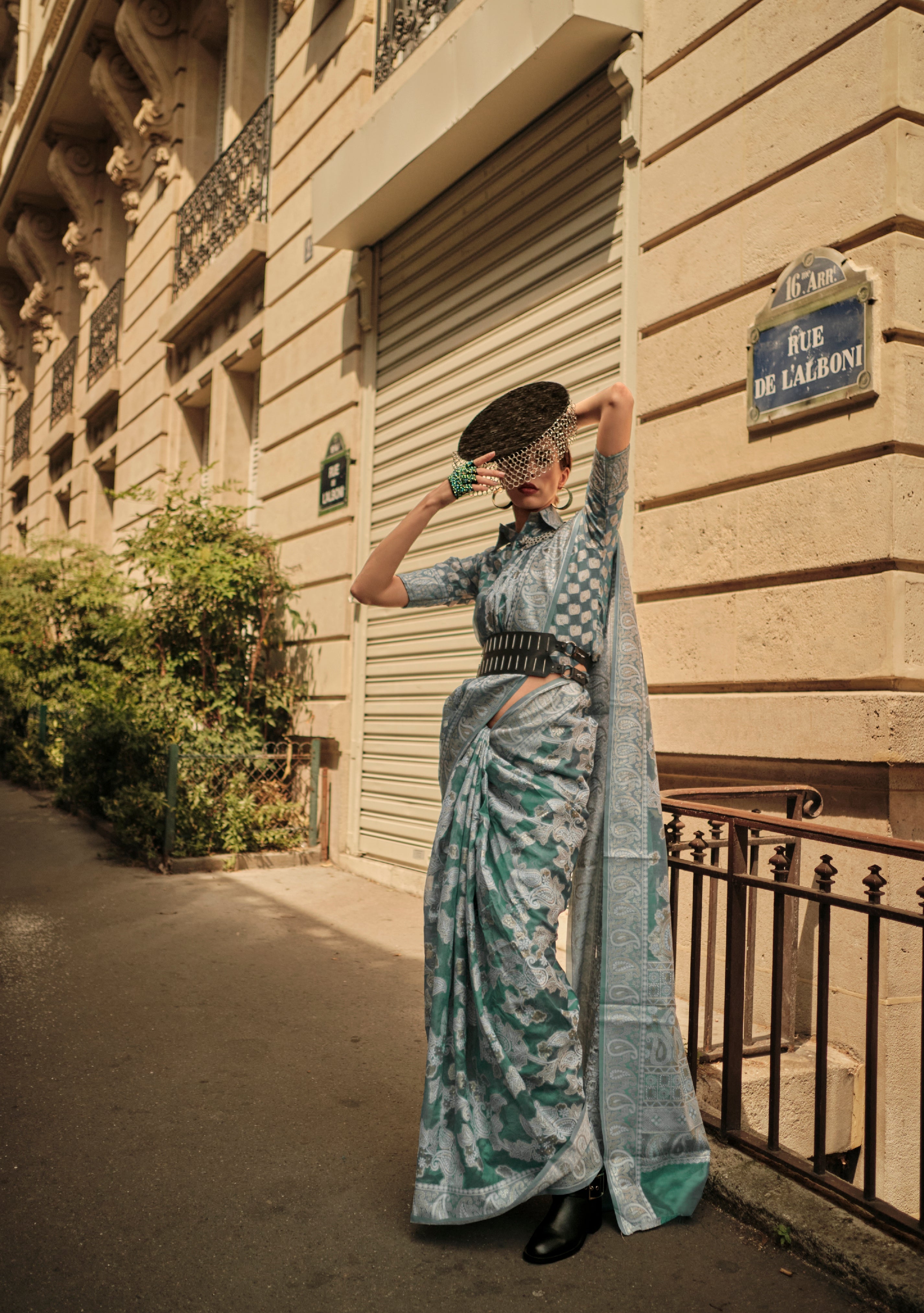
- Cascade Green Woven Lucknowi Chikankari Saree — the safest colour for a Lucknow summer function.
- Blossom Pink Handwoven Pure Mul Mul Cotton Chikankari Saree — genuine mul mul, and the one we would send to anyone dressing for June.
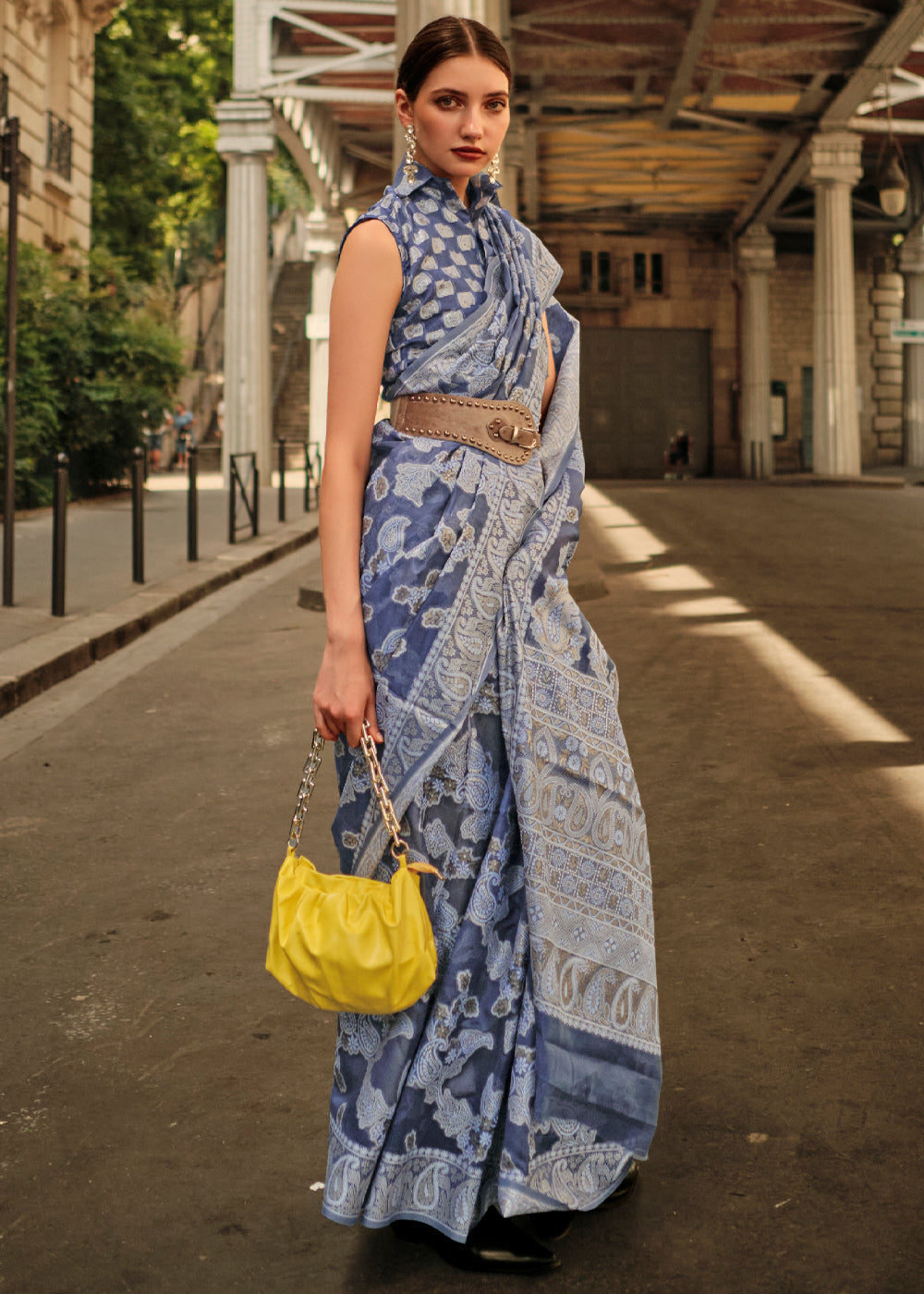
- Steel Blue Banarasi Handloom Woven Silk Saree — a handloom zari brocade with a lighter, more fluid drape than most.
- Camelot Purple Banarasi Woven Handloom Silk Saree — winter-wedding purple, ornate border, worth the weight.
Browse the full chikankari sarees collection, the Banarasi sarees range, or the lighter cotton sarees for peak summer. If you want the longer version of the Varanasi side of this story, our complete Banarasi silk saree guide covers weave types, zari grades and price tiers in full.
Ordering to a Lucknow address
We dispatch from Pune, and 226xxx pincodes are standard-service — typically three to five working days, longer during the Diwali courier crunch. Shipping is free on orders above ₹6,000; below that a delivery charge applies at checkout. If you add blouse stitching, note that stitched orders are not returnable — order stitching only when you are certain about the fit and the fabric.
Frequently asked questions
Is chikankari from Lucknow always hand-embroidered?
No. The GI tag protects the origin of Lucknow Chikan, but machine-embroidered chikan-style sarees are widely sold across the same markets. Check the reverse of the pallu: hand chikankari, especially bakhiya shadow work, is neat on the back, while machine work leaves long floating threads jumping between motifs.
Can I wear a chikankari saree to a Lucknow wedding?
Yes — for the mehndi, haldi, daytime nikah or a summer reception, it is the more appropriate choice, and far more comfortable in 40°C heat. For a winter evening ceremony, a Banarasi handloom silk carries better under artificial light and holds warmth.
How do I wash a chikankari saree?
Cotton and mul mul chikankari can be gently hand-washed in cold water with a mild detergent — never wrung, never brushed over the embroidery. Silk and georgette grounds should be dry-cleaned. Always dry flat and away from direct sun, which yellows white threadwork faster than anything else.

Shop the two-weave Lucknow wardrobe
If the stitch section is what you came for, our hand-embroidered sarees edit gathers the needlework pieces — chikankari alongside mirror-work and thread-work grounds — in one place. For the humid July-to-September stretch described above, the georgette sarees range is the fabric that recovers best from damp air without the zari risk. And for the winter half of the Awadhi wardrobe, our authentic handloom sarees cover the handwoven Banarasi silks and mul mul cottons this guide recommends.
Lucknow taught the rest of the country that a saree can be quiet and still be the best thing in the room. Start with the chikankari — it is the one you will reach for fifty times a year. Shop chikankari sarees →


Leave a comment
This site is protected by hCaptcha and the hCaptcha Privacy Policy and Terms of Service apply.