
The Saree's 5,000-Year Story: From Indus Valley Clay to Instagram Reels
The saree is not a fashion trend. It is a 5,000-year-old civilisational statement — worn by women across the Indus Valley Civilization around 2500 BCE, referenced in the Rig Veda around 1500 BCE, refined by Mughal emperors, politicised by freedom fighters, and reinvented by Bollywood every decade since. Here is the full story of how a single unstitched cloth became the most complex garment in the world.
The Oldest Garment Still in Daily Use
Archaeologists excavating Mohenjo-daro and Harappa in the 1920s unearthed something extraordinary: terracotta figurines draped in unstitched cloth, adorned with what appear to be woven borders. These weren't ceremonial robes — they were everyday dress. India was cultivating cotton as early as 2500 BCE, and the Harappan people were already using it to make finely woven fabric.
The word "sari" itself comes from the Sanskrit śāṭī, meaning simply "strip of cloth." That name appears in Vedic literature over 3,500 years ago. What's extraordinary is not just how old the saree is — it's how stubbornly alive it has remained. The Roman toga is in museums. The Greek chiton is in textbooks. The saree is on the Metro.
No other garment in human history has survived continuous daily use across this many millennia. That's not nostalgia — that's engineering. Six to nine yards of unstitched fabric that can be draped 80+ different ways, in climates from Rajasthan's desert heat to Kerala's monsoon humidity, for a 17-year-old college student and a 70-year-old grandmother, for harvest festivals and state banquets. The saree is adaptive software running on ancient hardware.

How the Mughals Transformed the Saree
When the Mughal Empire consolidated power in the 16th century, they didn't replace Indian textile traditions — they turbocharged them. The Mughals introduced zardozi embroidery (gold wire threadwork), chikankari (delicate shadow embroidery from Lucknow), and mukaish work (metal-chip embedding into fabric). They funded weaving clusters in Varanasi, Surat, and Murshidabad that survive to this day.
The Banarasi silk saree — arguably India's most famous weave — reached its peak of artistry under Mughal patronage. The characteristic kadhwa weaving technique, where individual motifs are woven directly into the fabric rather than embroidered on top, became the Mughal court's preferred textile. When you wear a Banarasi today, you're wearing a direct heir to 16th-century imperial taste.
But here's the often-overlooked detail: the saree blouse as we know it didn't exist during the Mughal era. Women wore the saree with the pallu (end piece) drawn over the chest and upper body. The structured blouse — the choli — came later, and from a surprising source.

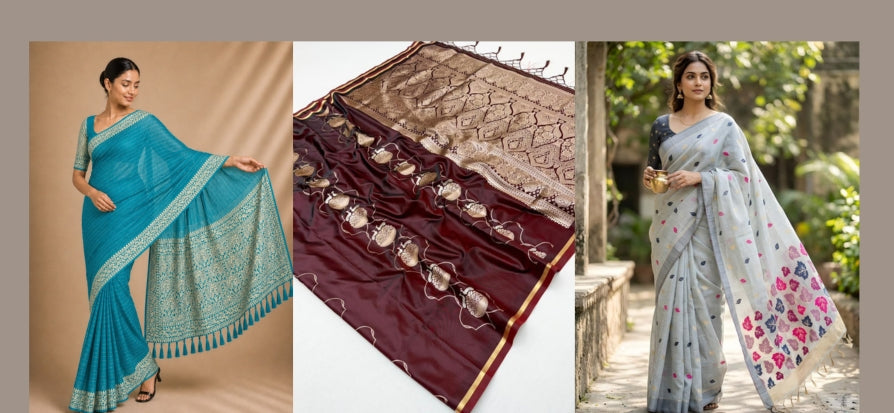
This Rhino Blue Kashmiri Jamawar Banarasi Saree from MySilkLove carries the same labyrinthine paisley motifs — called boteh — that defined Mughal textile aesthetics in the 1600s. The design language has barely changed in four centuries.
The Colonial Twist: How a British Viceroy's Wife Changed the Saree Forever
The British Raj brought Victorian morality to India — and it physically reshaped what women wore. Colonial administrators and missionaries viewed the bare midriff and uncovered upper body as indecent. The pressure to conform created a fascinating cultural negotiation.
The hero of this story is Jnanadanandini Debi, wife of Satyendranath Tagore (brother of Rabindranath Tagore). In the 1860s, she was repeatedly denied entry to social events in Calcutta because her traditional drape was deemed insufficiently modest by colonial standards. Her response? She adapted — but on her own terms. She popularised a new style of draping the saree with a fitted blouse and petticoat, creating what became known as the Brahmika or Bengal style. It's the draping style that most Indians today call simply "the saree."
This is a fact worth sitting with: the version of the saree you probably grew up watching your mother or grandmother wear — the one with the pleated front and pallu over the left shoulder — was effectively formalised in colonial Calcutta in the 1860s, partly as a response to British social pressure. The saree absorbed a colonial challenge and came out the other side more elegant and more widely worn than before.
The saree also became a symbol of anti-colonial resistance. During the Swadeshi movement of the early 1900s, women who burned British-imported cloth and wore handwoven khadi sarees were making a political statement as powerful as any public speech. The saree as patriotism — that's a chapter no fashion textbook covers.

Bollywood and the Saree: Seven Decades of Mutual Reinvention
No single force has done more to spread saree culture across India — and across the Indian diaspora worldwide — than Hindi cinema. Every decade brought a different saree moment that rewrote the fashion rulebook:
- 1950s — The Grace Era: Nargis in Mother India (1957) and Madhubala in Mughal-e-Azam (1960) wore sarees as symbols of dignity and sacrifice. Soft colours, full coverage, restrained silhouettes. The saree meant virtue.
- 1960s — The Freedom Turn: Mumtaz's electric orange saree in Brahmachari (1968) changed everything. It was body-conscious, kinetic, joyful — a saree that moved when she danced. The garment had never been sexualized and celebratory at the same time before.
- 1980s — The Zari Age: Rekha and Sridevi wore heavy Kanjivaram and Banarasi silks loaded with gold zari. The saree became aspirational — something you saved up for, something that announced arrival.
- 1990s — Minimalism: Madhuri Dixit and Karisma Kapoor stripped the saree back — lighter fabrics, simpler borders, pallu draped forward over the shoulder. The 90s saree looked modern without trying to be Western.
- 2000s onwards: Deepika Padukone, Priyanka Chopra, and Kareena Kapoor began pairing sarees with halter blouses, belts, and even blazers — turning the saree into a global fashion statement that needed no explanation on any international red carpet.

The Puce Purple Kanjivaram Saree at MySilkLove — with its signature golden zari border and rich silk base — is exactly the kind of saree Rekha would have chosen in her 1980s prime. It's a weave that carries four centuries of craft in every thread.
The Kanjivaram: A Living Archaeological Relic
Among all India's silk weaves, Kanjivaram (or Kanchipuram) from Tamil Nadu has the most unbroken lineage. Weaving families in Kanchipuram have been practicing the same korvai technique — where the body and border of the saree are woven separately on different frames, then interlocked thread by thread — for over 400 years. The result is a saree where the border literally cannot be separated from the body without the fabric unravelling. It's structural engineering disguised as textile art.
Kanjivaram received its Geographical Indication (GI) tag in 2005 — meaning only sarees woven in Kanchipuram using authentic mulberry silk and pure zari can legally carry the name. A genuine Kanjivaram weighs between 700g and 1.2kg, depending on the silk grade and zari density. When you wear one, you feel that weight — and it feels like history.
For a complete guide to identifying and buying an authentic Kanjivaram, read our Kanjivaram Silk Saree Guide.

The Saree in 2026: Still Evolving, Still Alive
Here's an opinion that might be unpopular among purists: the saree has always survived because it changes. Every generation that declared the saree "dying" was wrong — the saree was just becoming something new. Pre-stitched sarees, saree gowns, dhoti-style drapes, sarees with sneakers — none of this is a corruption of tradition. All of it is the tradition doing what it has always done: adapting.
The real threat to saree culture isn't Gen Z styling it differently. It's the homogenisation of fast fashion, the disappearance of regional weave clusters, and the replacement of handloom with powerloom imitations. The way to honour the saree's 5,000-year story is to buy from weavers who are still writing that story — not to buy a machine-made replica that looks the same but carries none of the history.
Frequently Asked Questions
How old is the saree?
The saree is at least 5,000 years old. Archaeological evidence from the Indus Valley Civilization (circa 2500 BCE) shows terracotta figurines in draped garments, and the Rig Veda (circa 1500 BCE) contains references to woven cloth draped over the body. It is one of the oldest continuously worn garments in human history.
Who invented the saree blouse?
The fitted saree blouse was popularised by Jnanadanandini Debi, wife of Satyendranath Tagore, in colonial Calcutta in the 1860s. Adapting to British social norms while preserving Indian identity, she created the modern blouse-and-petticoat style that most Indians today consider the "traditional" way to wear a saree.
Which saree weave has the longest history?
Kanjivaram (Kanchipuram) silk sarees from Tamil Nadu have one of the longest documented weaving lineages — over 400 years of continuous practice using the korvai interlocking technique. Banarasi silk sarees reached their peak under Mughal patronage in the 16th century and are equally ancient in their craft heritage.
Shop heritage silk sarees at MySilkLove → Explore our Silk Saree Collection — every piece sourced directly from weaving clusters that are still writing the saree's 5,000-year story.

Wear a Piece of the Story
Every weave in this history is still being made today. Own a chapter of it — browse these MySilkLove pillars and filter by price:
- The full living archive of India's weaves: explore our pure silk sarees.
- The Mughal-court weave with kadhwa motifs from this story: shop our Banarasi silk sarees.
- The 400-year korvai lineage of Kanchipuram: browse our Kanjivaram silk sarees.


Leave a comment
This site is protected by hCaptcha and the hCaptcha Privacy Policy and Terms of Service apply.