
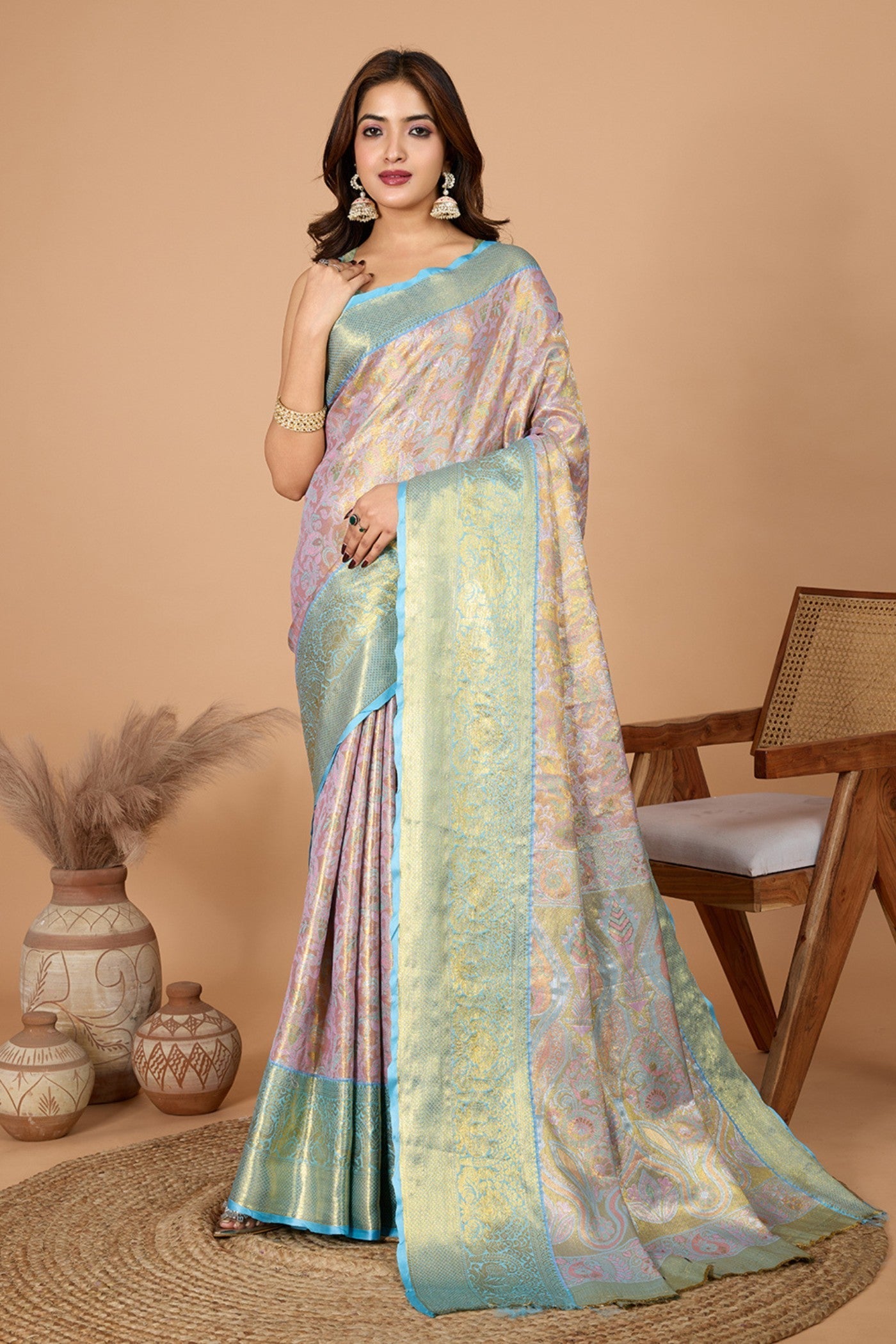
Types of Silk Sarees in India: 12 Weaves You Can Actually Buy, Decoded (2026)
India has more than 30 recorded silk saree traditions, but roughly a dozen account for almost everything you will actually find for sale online today. The rest survive in small weaving pockets or as made-to-order commissions. This guide covers the twelve you can genuinely buy, and more usefully, how to tell them apart when every product photo looks the same.
First, read the fibre - not the name
A weave name describes a technique and a place, not a guarantee of pure silk. Banarasi tells you the saree was woven in the Banaras brocade style; it does not by itself tell you whether the base yarn is mulberry silk, a silk blend, or an art-silk substitute. All three are legitimately sold under the same weave name, and the price gap between them is large.
So read the fibre line separately from the weave name. On our own silk sarees listings a blend is labelled a blend, because the honest version of this information is the only version worth having.
The South Indian silks
1. Kanjivaram (Kanchipuram, Tamil Nadu)
Heavy mulberry silk, thick zari, and a contrast border that is woven separately and interlocked with the body. GI-tagged in 2005-06. This is the heaviest mainstream silk saree in India and the one most associated with South Indian weddings. Browse Kanjivaram sarees.
The expert test: a true Kanjivaram is woven by the korvai method - body and border are set up on two different warps and locked together by hand, often with three shuttles. Run your thumb along the border join from the inside. You should feel a faint, slightly serrated ridge where the two warps interlock, and the border will not peel away as a separate strip. A printed or single-warp imitation has a perfectly smooth join, because there is nothing there to interlock.
2. Pattu and soft silk
Pattu simply means silk in Tamil and Telugu, so it functions as an umbrella term across South Indian silks rather than one weave. Soft silk is the lighter, more drapeable cousin of the Kanjivaram - same visual vocabulary, far less weight on the shoulder. See pattu sarees, soft silk and south silk.
The North Indian silks
3. Banarasi (Varanasi, Uttar Pradesh)
Brocade weaving with gold and silver zari, GI-tagged in 2009. The vocabulary matters here: kadhua means each motif is woven discretely with its own small shuttle, so the reverse shows no floating threads. Fekua motifs are thrown across the width, leaving long floats on the back. Turn the saree over - the reverse tells you which one you are holding. Browse Banarasi sarees.
4. Chanderi (Madhya Pradesh)
A silk-cotton weave with a distinctive glassy transparency, GI-tagged. Light, crisp, and holds a pleat well in heat. See Chanderi sarees.
5. Maheshwari (Madhya Pradesh)
Reversible borders and the signature bugdi and chatai (mat) patterns, traced to Ahilyabai Holkar's 18th-century workshops. Lighter than Chanderi and more everyday. See Maheshwari sarees.
6. Kashmiri Jamawar
Dense paisley - the boteh motif - worked across the field rather than confined to a border. Very little competition in this category online. See Kashmiri Jamawar sarees.
The western and eastern silks
7. Paithani (Maharashtra)
Tapestry-technique pallu with peacock, Bangdi Mor and Muniya motifs, and an oblique square border. The pallu is woven without a mechanical jacquard on true handloom pieces, which is why the reverse of a genuine Paithani pallu reads as a clean mirror image. Browse Paithani sarees.
8. Patola (Gujarat)
Double ikat, where both warp and weft are resist-dyed before weaving so the pattern exists in the yarn itself. The classic test: a true double ikat Patan Patola looks identical front and back, with no right side. Single-ikat and printed versions do not pass this. See Patola sarees.
9. Jamdani (Bengal)
A supplementary-weft technique in which motifs are added by hand during weaving, thread by thread, with no shuttle. GI-tagged. Among the most labour-intensive weaves still in production. See Jamdani sarees.
10. Tussar (Bhagalpur and central India)
Wild silk with a natural golden slub rather than the even sheen of mulberry. The irregularity is the point, not a defect - ghicha and kosa yarns are graded on it. See Tussar sarees.
The modern and blended silks
11. Organza and tissue silk
Sheer, structured, and increasingly the default for evening events. Organza is woven from tightly twisted yarn; both pure silk and synthetic versions are sold widely, so the fibre line matters more here than anywhere else. See Organza sarees.
12. Raw silk and dola silk
Raw silk keeps the texture and slub of unprocessed yarn. Dola silk is a viscose-silk blend with a fluid drape - a blend, and we say so. See raw silk and dola silk.
Which weave for which occasion
- Wedding, as bride or close family: Kanjivaram, Banarasi, Paithani, Patola
- Wedding guest, long day: soft silk, Chanderi, tissue
- Festival at home: Maheshwari, Tussar, Jamdani
- Reception or evening: organza, Kashmiri Jamawar
- Office and daywear: Chanderi, Maheshwari, Tussar
Weight is the deciding factor more often than colour. A Kanjivaram can run close to a kilogram; a Chanderi is a fraction of that. If you are draping for eight hours, choose for the shoulder first.
Frequently asked questions
Which silk saree is the most expensive?
Handwoven Kanjivaram and pure Katan Banarasi sit at the top, because both use heavy mulberry silk and real zari and take weeks on the loom. Our Kanjivaram price guide and Banarasi price guide break down what each tier actually costs.
How can I tell pure silk from art silk at home?
The burn test is the reliable one: real silk burns slowly, smells like burnt hair, and leaves a crushable black ash bead. Art silk melts, smells chemical, and leaves a hard plastic bead. Test a single thread from the inside seam allowance, never the pallu.
Is a GI tag the same as pure silk?
No. A GI tag certifies origin and method, not fibre content. A GI-registered weave can still be made in a blend. Check the two facts separately.
Which silk saree is best for a beginner?
Soft silk or Chanderi. Both hold pleats without slipping, weigh little, and forgive an uneven drape - the two things that make a first silk saree difficult.
Shop by budget, not just by weave
Once you know which weave you want, the next question is what it should cost - and that is where these twelve separate fastest. Two of the heaviest names above have their own price-capped edits: Kanjivaram sarees under ₹5,000 and Banarasi sarees under ₹5,000. If you would rather shop the band than the weave, the ₹3,000 to ₹5,000 saree edit cuts across the traditions above in one place. Read the fibre line on each listing exactly as described at the top of this guide - a price band tells you the budget, not the yarn.
Explore the full range of handloom sarees or start with the complete silk saree edit.


Leave a comment
This site is protected by hCaptcha and the hCaptcha Privacy Policy and Terms of Service apply.